Ep28 Alexis Hill—How This Candidate for Governor Plans to Fix Nevada's Broken Systems
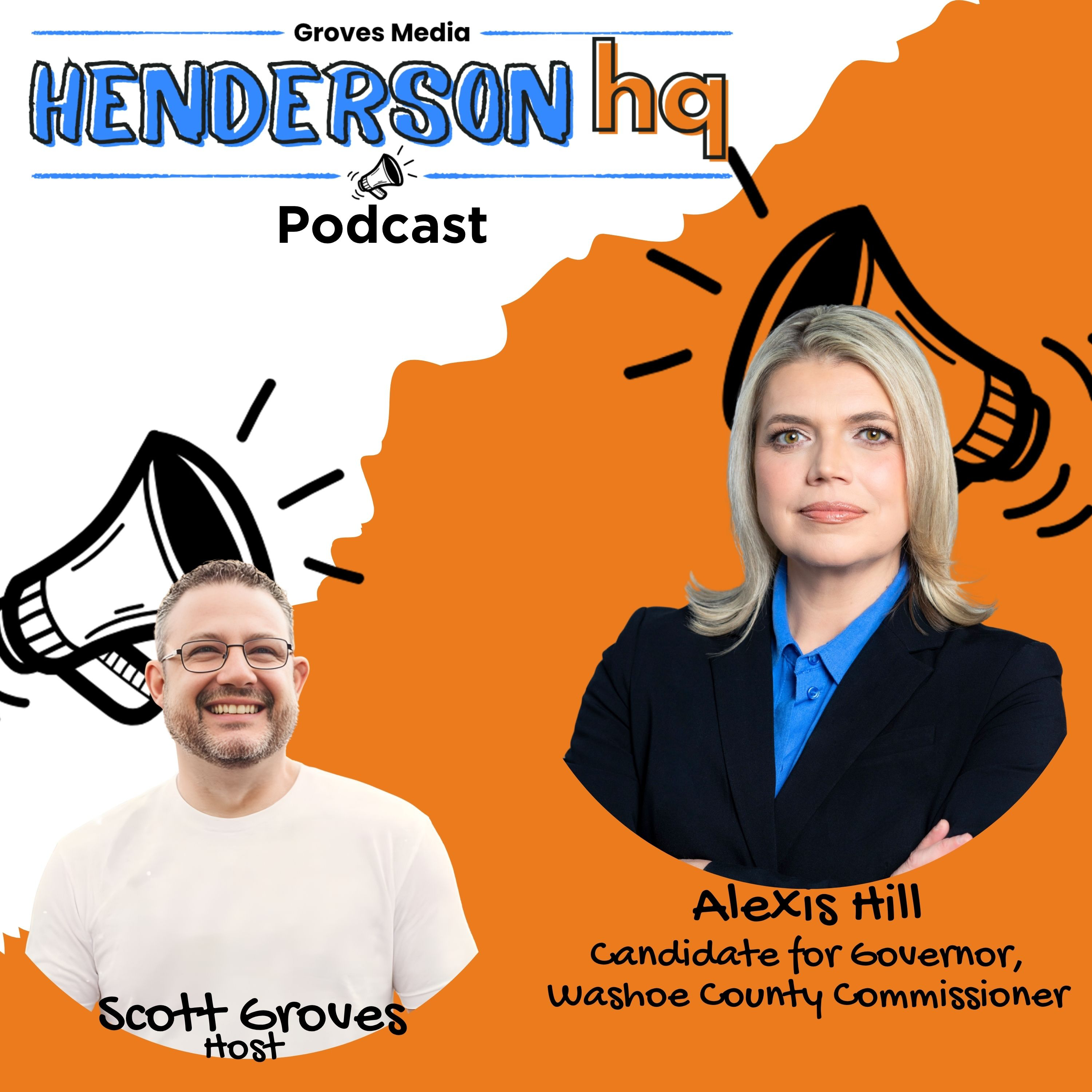


Connect with Alexis and learn more about her campaign: https://alexisfornevada.com
Don't forget to SUBSCRIBE to the HendersonHQ Newsletter: https://hendersonhq.com/Subscribe
Check out our website for all our local stories & community updates: https://hendersonhq.com/
Follow our instagram for deals and cash drops: https://www.instagram.com/TheHendersonHQ/
Interested in advertising in our newsletter to 25,000 local Henderson Residents? Let's book a call: https://calendly.com/scottgrovesteam/catchingup
______________________________
Scott Groves sits down with Alexis Hill, Washoe County Commissioner and candidate for Governor of Nevada, for a conversation that surprised both of them. Scott is a registered Libertarian. Alexis is a Democrat. They ended up agreeing on more than they disagreed on.
In this episode, you'll learn how Alexis built a homelessness coordination model in Washoe County that houses people for $68 a night (versus the $600 it costs to jail them) and why Nevada handing $400 million in tax abatements to a data center that created 73 permanent jobs is exactly the kind of deal she wants to end on day one.
They also dig into what $2 billion more per year in school funding would actually require, corporate ownership of single-family homes, the trades gap, rent stabilization, data centers and clean energy, and whether executive orders are a real governing tool or political theater.
Find all the show notes and links here: https://podcast.hendersonhq.com/28
Alexis Hill 0:00
We know that our schools are failing. We know that our healthcare system is unacceptable. We know that seniors and kids are falling through the cracks. So we got to do something. Politics is relationship-based. We need to talk to each other, bring industry to the table. We can't do this without mining and gaming and big tech and everyone else coming to the table and talking about what they're willing to give up, because not one industry is going to fix this, right? It's going to take everyone putting in a little.
Scott Groves 0:30
Welcome to Henderson HQ. This is the podcast where you get all the stories behind the businesses that make our community tick. Don't forget to subscribe to our weekly newsletter. Hey, ladies and gentlemen, welcome to the Henderson HQ podcast. Don't forget to subscribe to the newsletter and check out the website at Henderson hq.com We're here today, actually, with my new friend Alexis Hill, who is running for governor of Nevada, and I was super excited when your team reached out, and then I told your team about a little bit of my political views, and you're like, no, the whole point is to talk to people that maybe we agree or don't agree with, so I want to start just with you, because at the end of the day, politics across the board, from city, as you may know, is going on in the city of Henderson, all the way up to obviously national people are really rude and mean and evil, and I think when you know somebody's story, it's kind of harder to hate somebody when you know their story, right? So some people might look, whether you have a D in front of your name or an R in front of your name, they immediately have a lot of opinions. So, can you just tell me, like, where you come from? Because this is our first time meeting, and about you and your family, because that's the stuff that matters to me. Yeah, this
Alexis Hill 1:31
is all about personal connection, and that's why I like politics, because it's all about relationships. And I actually grew up in Nevada, I'm one of the rare ones, and was born and raised in Northern Nevada. I grew up in Sparks, Nevada, which is a bedroom community of Reno, and I was in a very politically active and engaged and community-minded family who wanted just to make the state better. My parents were incredibly focused on giving back their whole careers, and also ran small businesses, and were really just every kitchen conversation was about what was going on in the community, and how we could do something about it. And I used to walk to school, and I didn't have a sidewalk, and it pissed me off. I went down to the city council, and I asked them to help me with that. They were very nice to me, but I didn't get a sidewalk out of it, and, but it did make me want to get involved in local government, and I thought, oh my gosh, that's where the action is, that's where things can get done for your local community, and either can be great or bad. And went away for college came back to the city of Sparks, worked as a planner, fixed that sidewalk, made a developer pay for it, but I've been working in local government my whole career. I then went to the city of Reno, I did economic development, I did a lot of support for small businesses, especially during Covid. We were talking about that earlier, and really, I feel like I was part of Reno's Renaissance during getting climbing out of the recession. As we all know, in Nevada, we were hit so hard, and then I was watching the county commission, and they were making really bad decisions for the community, very politically motivated decisions, and not really focusing on how they can make things better, and so I ran against a two-time incumbent Republican, and I flipped that seat by 10 points, and I ran about really fixing things in the community. Homelessness was the biggest concern that was happening of the day, and I am so thrilled. I actually was recently re-elected and won by 15 points, so I think it shows that my community is like
Scott Groves 3:45
doing the right thing.
Alexis Hill 3:46
Yeah, they're happy, they're happy. I mean, things are not perfect, right? That's why I'm running for governor. It's still a mess on the state level and working in the local level on these issues on the ground, the biggest issues of our day: homelessness, housing, mental health care and making sure that you can take care of vulnerable seniors and kids. We don't have enough money, we don't have enough resources to do that, and I don't have a problem with Nevada being a low-tax state. Don't get me wrong, I grew up here, so I very much like a lot of the things about the libertarian lifestyle of being a Nevadan and making sure
Scott Groves 4:21
just buttering me
Alexis Hill 4:21
up, I know, watch out, and making sure that we have a small government. I think that that's fine. I'm not disagreeing with that, but it is so small and it is so inefficient that people are falling through the cracks, and so as a county commissioner, trying to battle these major issues really on our own, and trying to piece together the resources we have, and seeing that the legislature only meets every two years for 120 days.
Scott Groves 4:49
That was crazy to me. No, my friend Christian Bishop was thinking about running again for state legislator. I'm like, wait a minute, every two years you meet for a couple months? That blew my mind. Yeah, sorry, I didn't mean to cut you out. That was, that was shocking. To me, he's like, "Yeah, if I do this job for the state, I think I'll make $4,200 a year or something. I was like, "Oh, okay, great.
Alexis Hill 5:06
I know, I know, it's brutal, and they don't get a whole lot done for, honestly, the community, because it's not enough time, and because special interests really are ruling the day at the legislature, and I'm frustrated. I'm a frustrated mom. I met my husband in grad school. We were in a public budgeting class, so it was very romantic. Fell in love. Oh, that sounds real, talking about balancing, you know, government budgets. And then we got married, and I have a four year old and a two year old foster daughter.
Scott Groves 5:40
Oh, you're right in the heat of
Alexis Hill 5:41
it. I know, I know.
Scott Groves 5:42
So, you thought you'd run for governor, because that would be fun to add. I know, isn't that
Alexis Hill 5:46
crazy? But I also am like, can I wait? Can the state wait? And I have been looking for elected officials to run on solving these major problems, and honestly, no one wants to talk and speak to the voters and tell them what is actually happening on the state level, the state is broke, the county, all the counties are broke, the cities are broke, and we don't have enough resources to just meet the modern needs of Nevada, and I, it's been thrilling to come down here, I announced my candidacy in September, and I've loved being in Clark County. I'm here every week, from anywhere from three days to an entire week, to make sure I connect with the voters. I've done like 200 plus events with the community that I've hosted, come out to a library, come out to a coffee shop, meet me, let me buy you a coffee, and it's been a joy, I've connected with 1000s of voters, and this has been a grassroots campaign on the issues, and the issues are that we need to tax billionaires and corporations, make them pay their fair share, and invest in Nevadans, and especially during this really tough economic time, and was just talking to some entertainers at a round table we did at a library earlier, and they're suffering, I mean, people who are contract workers, who are getting in the gig economy, they're not counted towards unemployment, and they are suffering, and they need support. And so, talking to small businesses, and I know you talk to a lot of small businesses, and have several small businesses, they are suffering as well. And so, I want to see how I can support these community people and their organizations, and make sure that they succeed. I want to treat small businesses the way that we treat big businesses in
Scott Groves 7:30
Nevada. I wrote that down, by the way.
Alexis Hill 7:32
Yeah, I want to give you a tax break in your, if you're operating on a property you own. I want to give you a five year property tax holiday. I don't want to make you pay personnel tax. Why am I making you pay to hire people in the state? And I actually want the big guys, Walmart, Amazon, and Tesla, to pay their fair share. And so you know there are so many opportunities to make this state better to ensure that we are ready to serve the modern needs of our community, and we can't do it without resources, and that's why I'm running. So, it's a joy to be on the pod, and can't wait to talk about all the issues.
Scott Groves 8:10
That's awesome. And when I, when your team reached out, I was like, I wrote back, and I was like, 'Hey, just to be clear, you're obviously running for the Democratic inauguration. I'm a registered libertarian, so my ballot was much shorter than my wife, tiny. It was tiny. Yeah, so it was kind of nice. I only, I only still like, like eight bubbles instead of a set of 18 or 80, or whatever it was. But you know, I think people are so quick to go to where they disagree and angry and you're wrong and I'm right. I looked at your whole policy and read it, and then I had Claude analyze it based on my opinions, because Claude knows a lot about my political opinions, and so I want to start in some places that we probably agree a lot. You know, when we moved up here five, six years ago, one of the things my wife and I said was like, well, you get what you pay for, right? We're not going to have any income tax, property taxes, much lower, pretty much everything here, except for car insurance, is cheaper than California, but there are some trade-offs, you know. I was doing some Google searching this morning, and in a lot of stats, we're like 49th in the nation in public schools, and I was just watching a video before I came in here that the Clark County School District is something like several billion dollars underfunded just for basic maintenance of the properties, and so our solution was we opened our own little micro school. I would love to be a little participate in public school, because that's where I grew up going, and like, if it wasn't for my wrestling coach, I'd probably be a drug addict or a degenerate. So, like, I have a soft spot in my heart for kids going to public school. But can you talk a little bit about, like, what's the plan to make schools better? And then specifically, one of the things I really loved on your, on your policy was create job readiness programs, because I can tell you, my kid would probably be my son, would probably be one of those people that would test like below grade level, and he's not particularly academic, he might get there one day, but we're pretty sure he's going to do a job where he works with his hands, yeah, and when I look at all public schools these days, I'm like, well. If you're not on the college track, then there's really nothing for you, or you're kind of like the black sheep of the of the curriculum that they currently have built out. So, when you said, like, let's have job readiness programs, what does that mean, and how you think we can do some, do some heavy lifting and improvement for the Nevada schools?
Alexis Hill 10:16
Absolutely. Well, yes, we are 48 and per pupil funding in the United States, so we are, you know, holding up, holding up the bottom here. And the last time government revenues kept up with inflation was 1990 in Nevada, so we've tripled in population since then. So we have got to invest in our schools. It is about $2 billion we need per year to get to the meaty part of the bell curve of 25 or 24th in investment in our per pupil funding, and we got to tackle that. So, there's a few ways that we can get there. I will also tell you, I was a female wrestler, believe it or not. My dad forced me to do that. Yeah, made me strong, but I hear what you're saying. I grew up in public schools, great schools, but even under-resourced when I grew up here, and even worse now. Teachers I have talked to all the time, 40 kids in their class, no teacher aid. This is a kindergarten class. How are they supposed to teach these kids how to read? I mean, come on,
Scott Groves 11:18
no chance.
Alexis Hill 11:19
Yeah, exactly, it's unacceptable. And I know a lot of parents who have pulled their kids out of the school system because they're special needs and they're not getting what they need from the schools, and I'm certainly not faulting the teachers, I'm faulting the lack of resources for that, and I've been talking to a lot of people in the education system, and they're like, if you're going to give the money, you need to have accountability, and I absolutely agree with that. We need to prepare kids for the jobs of the future, but when you graduate from high school, you better be on a track of what you're going to do with the rest of your life. And in Nevada, especially, we don't set up young adults for success if they don't go to college, and it's because there you could go to the casino and easily get a job, but that job will not pay you enough to live and actually like live that American dream. It used to when I grew up here, you could work at the casinos and you could buy a house. So many of my friends' parents, that's exactly what they did, and they created that incredible dream for their family, and we're able to do that investment, but now this is, you'd have to do three of those jobs in order to just get a one-bedroom apartment, you know. So, I think that what we need to do is set up opportunities for kids to work in the trades and get them the work immediately. The only way this is where the trades are having a really tough time, and why they want to see economic diversification in our state, because they aren't getting the jobs, so the trades can't hire. There are so many kids who want to get into these good paying careers, that's what they are, they're careers, but unless the work is there, they can't put them into the training program, so that's what my Nevada Works program is all about. I want to put 15,000 new jobs on the ground by putting kids and young adults, and even adults who are looking to change their careers into the trades by rehabbing our roads by fixing our parks and our trails by investing in our schools, our school buildings, and our public government buildings, and actually creating opportunity for them to continue that work, because if you have enough money for your CIP, then you can continue to hire these people to actually do the work that needs to be done, and you don't have to always tell, you know, for example, Amazon, who wants to have a warehouse in Nevada, that they don't have to pay property tax, so you can build their warehouse and use union labor, which is a plus, but then when they're not building, they don't have the jobs anymore, so this is a sustainability issue. It's investing in ourselves, so if we invest in our infrastructure and we invest in those good paying private jobs, they're not government jobs, and we invest in private contracting businesses and actually stimulate our economy by investing in our people instead of billionaires, and that's that's the plan. I also want to see if kids want to be in small business, they are entrepreneurial. We need more opportunities for kids to learn how to do that. I've spoken to so many small business owners who are like, I know friends who have gotten into this because they love or have a passion for something in particular with the small business, but they can't survive because they don't know how to do it, so incubator programs, startup programs. I think that the community should be able to come to the state and say, I need help with xyz, I want to go to work, let's put them to work. If we have people who are willing to work, like Nevadans are the. Artist working people, I know they are not looking for a handout, they are looking for opportunity, and our opportunity is slipping away. That's why I think we need this change and a new way to look at government.
Scott Groves 15:11
Hey guys, just a quick add from our sponsors here that make this podcast and our newsletter possible. Wanna give a shout out to Ethereal Med Spa, a gym for your skin, so doesn't matter whether you're doing anything proactive all the way up to spot removal, all the way up to beautification, right, or vanity, ethereal med spa, they got you covered. Scott Wright over at Wright Autobody, love them. So, anything from a scratch and dent to a big insurance job all the way up to a custom rebuild of a classic car, they got you covered. And shout out to my buddy Casey Halstead, owner of 10th Planet Jiu Jitsu, which now has three locations. They just opened a new location on the west side, so they got our Henderson location, they got a mid city location, and they've got a west side location. So anywhere in the valley where you're looking to train jiu jitsu, check out 10th Planet Las Vegas. Now back to the show. So, I'm going to give you a story, and quick shout out to my friend Nick. He owns a custom welding shop over here called Customs Customs, and we found him online. He does welding classes over the summer, and one in the fall, or something - four, or not the fall, because he coaches football, one in the winter, one in the summer for young kids. So, we took our 10 year old there, because he loves working with his hands, and I thought, shout out to Nick. It was going to be like four weeks of safety briefings.
Alexis Hill 16:25
Yeah, it
Scott Groves 16:26
was not like 30 minutes into the class. They're using plasma torches and welders and all kinds of crazy stuff. And I was looking at, and I pulled him aside. I was like, this is brilliant, because you're getting us to pay you to have the kids have an experience. You're getting the materials donated from a business that wants you to do a project that doesn't have to be perfect.
Alexis Hill 16:44
Yeah,
Scott Groves 16:44
and then I know what you're doing, you can't find welders or tradesmen, so you're building like your reserve edge of people that are coming to work for you. And he's like, "Yes, guy. He's like, "I'm about six months behind, I can't turn on any marketing, I can't do anything because, like, the custom fences and all the fancy stuff that they do. He's like, "We're six months behind. I cannot find enough workers that are trained, or that are willing to be trained, like on-the-job training, to be a welder. And I'm like, "Well, Gabriel's going to stay on this path, because if he can, as a backup plan, make a couple 100 grand welding, that would be amazing, right?
Alexis Hill 17:17
Yeah, and
Scott Groves 17:17
so it just feels like there's a huge need for the trades. Yeah, I have to ask, because this is my pushback, my parental, my personal issues, is like every time I hear any politician talk about a program, I just immediately think of, like, cost. Okay, what taxes are going to raise? Yeah, what taxes are going to be wasted as it funnels through seven different layers of bureaucracy.
Alexis Hill 17:37
Yeah,
Scott Groves 17:38
and so it's like, I don't think anybody, myself included, mine's paying more property taxes or more expensive parking tickets, of which I get several. I don't mind that if I feel like it's not wasted, right? Like coming from LA and California, my knee-jerk reaction is every extra dollar taxed to go to some program
Alexis Hill 17:56
is
Scott Groves 17:57
like 72 cents wasted. So, how do we do that as a state? If it's like, I let's say I agree with you, we need a lot more infrastructure, we need more funding for schools, we need more. How do we do that? Like, you can use either the trades or the school, like, cool, we need an extra $5 billion for schools. I want that to go to teachers and the programs, not 32 new levels of administrators and more bureaucracies. Yeah, how? How can you, how can you like balance both those thoughts?
Alexis Hill 18:22
Yes, I mean, I'm with you. I think that more bureaucracy is not the way, and making sure that we're not layering on paperwork and administration and red tape, making it harder for people to access these programs, is going to be key. And it's interesting, this woman who used to work as a trustee for the school district, she got sick of it. She got out of it because she's like, all we do is hand out contracts to these giant corporations who are wasting our money with all of these different programs that we're not even seeing the right outcomes on, and so I think that there needs to be more oversight from the state, and this is what's missing as well, by the Department of Education, which I met a woman who works at the Department of Education in Henderson. I had a happy hour with voters last night, who's telling me, like, no one, no one works there, they don't get paid enough, so even working at the state is like, there's a ton of vacancies, and they're not able to get the job done, but I think there needs to be more oversight on how we can make sure that this money is being used to the highest and best use, and I think really what you're saying is that government hasn't been working, there's there's a reason that people have gone to burn it down, like in our lifetime, less and less trust of government, and it's heartbreaking, because I like, love government, and I believe in it.
Scott Groves 19:47
You met your husband in the policy class, that's what you must really love it.
Alexis Hill 19:50
Exactly, so I mean, it's my passion. I love talking about it, I love thinking about the fixes, but if we aren't delivering for people, then yeah. I understand why they don't even necessarily want to go for democracy anymore. I'm not saying that's right, but I understand the feeling, and I think that we're seeing a movement in this country of people standing up and saying, I want more from my politicians. I don't want politicians who take a check from a special interest and that's who they work for while they're in their seat. I want a politician who's actually going to deliver on what they're telling us that they want to do, which is why I have so many policies on my website that no one's going to read, or maybe people will read, who knows. But to make it clear, I want to be held accountable. I want to actually deliver on the things that I am talking about, because I think that is your job as a citizen to make sure that your elected official is actually delivering for you, and I've done it at the county in our homeless programs. We are seeing Washoe County is being held up as a model for the work we've done of getting people housed, getting people to help that they need. We just don't quite have enough resources to finish the job. I mean, there are seniors, it's horrific, and I know that you was it shine the light that you had on recently, and yeah, that you talked about this in detail,
Scott Groves 21:12
super eye opening.
Alexis Hill 21:13
Yes,
Scott Groves 21:13
of like, how there is, there needs to be more resources, but there is a lot of resources out there that just aren't, they're not
Alexis Hill 21:18
coordinated.
Scott Groves 21:19
Yeah,
Alexis Hill 21:19
exactly, and that's what we've done at the county, is bring the cities together, bring together the nonprofits, and we have a continuum of care that we work together and meet every week on getting people housed, the most vulnerable, delicate, fragile people. We're getting them housed as soon as we can, but again, these are seniors that are dying in our shelters, our emergency shelters, they're disabled, it's not okay, they most of these people have worked, they just didn't make enough money, or they got out of the job market to be a caregiver, and obviously don't make social security being a caregiver, and so they don't have enough to retire on, they have no social safety net. Yes, some of these people have addiction issues, yes, some of these people are problematic people, and potentially have criminal elements, but for the most part, these people are poor, and these people didn't make enough money, and it's detrimental to our economy to have people dying on our streets. And look at downtown, I feel so bad for those businesses. They deserve, yes, they deserve. And you heard Mayor Berkeley say this is my number one issue, is homelessness, because her downtown is suffering and businesses are suffering because it's out of control, it's not on a strip, you know, they certainly take care of areas that up, yeah, exactly, but for our small businesses, or
Scott Groves 22:32
you go to Fremont Street, it's really bad,
Alexis Hill 22:33
so yes, exactly, but these are the folks who, you know, I once had a legislator tell me, I wish that the people had a lobbyist, and I'm like, that's you, that's your job. So these, these are the small guys that may not have a lobbyist.
Scott Groves 22:49
Like, tell me you don't understand without telling me you don't understand. Yeah, the homeless situation is interesting. Talking to the group from Shine a Light Shine a lot of light for me on the problem, because it's like, again, growing up in LA, the idea that there was a family that just misses a paycheck and then they're homeless, I haven't seen that. Maybe it exists, I haven't seen that. It's mostly drug addiction, mental illness, whatnot. And at least in California, they're not willing to address that. What I did appreciate about the conversation we had on homelessness a couple weeks ago was he's like, hey, whether you become a drug addict, are a drug addict, and that caused you to be homeless, or whether you're homeless and you're so miserable you're trying to self-medicate with drugs, who really cares? Yeah, we just got to get him into a program to get him off drugs, and whatever, however we want to talk to him. And he's like, I could give you 1000 different stories of how drug was the culprit, and then drugs were the outcome. It doesn't really matter, we just have to get it into a program, right? So, can you talk, maybe specifically, about a couple of the things that you have done in Washburn County to, like, help stem the tide, because I think it's only going to get worse.
Alexis Hill 23:51
I will, I agree, as the economy gets worse, and that's part of the reason that we may disagree about this, so we can fight about it, I'm sure, but I want to temporarily cap rents to just get people stably housed, because I can't tell you how many seniors who have worked, have been teachers, are retired, can't work anymore, who are not stably housed, who are struggling to stay housed because of their rents increasing, and so I think that we've got to do some preventative work on the state level to stabilize rents and make sure that landlords have enough money, yes, to rehab their properties, but also that, and the government can help with that, by the way, and but also make sure that people can stay housed, and what we've done at Washoe County is we have a team with Reno and Sparks, we used to fight each other, so what we used to do before I got elected is there was a homeless person in Reno, downtown Reno. They moved them to Sparks, and then Sparks would move them back to Reno, and then they'd end up in the county somewhere, and they'd just be moved all around the town instead of actually sitting down. And seeing how you can find this person the proper resources, that's happening right now, here, you know, and I'm not saying all
Scott Groves 25:06
I know, it is,
Alexis Hill 25:07
yeah, exactly, we're just moving people around to different jurisdictions and hoping that the problem will disappear, these are real people, this is a moral issue, and it's a real financial issue, because if they end up in the hospital, if they end up in our jails, it's millions of dollars. Million dollar, Marie. Have you heard this story?
Scott Groves 25:26
No,
Alexis Hill 25:26
it's about a man who was homeless in downtown Reno, who died of cirrhosis of the liver, but he was known as known very well by the police. He didn't really do much of anything wrong, except, you know, being publicly drunk and go to jail or go to the hospital, but when there was someone, a police officer, who could get him into even a motel temporarily and check in on him, he did so much better, and he was on a better track. And this is called - they now have a technical term for it - permanent supportive housing. So you get into housing, and then once you're there, there is essentially a social worker who's like, did you pay your bills, do you have enough food in your refrigerator, did you get your medication? These people need help, they need a support system, like we all need a mom. I'm sorry, like I have a foster daughter, she needs a mom, like we humans need support and connection, and someone checking in on them, and a lot of these people do not have anyone, and so when they did that, he was stably housed. Well, he ended up dying. They did the math on how much it costs the county, the city, the hospital system, over a million dollars, and this was in the 80s, so
Scott Groves 26:41
right,
Alexis Hill 26:41
it's like far more now,
Scott Groves 26:43
triple that.
Alexis Hill 26:44
Yes, I've heard different numbers about homelessness, because we're the point in time count hasn't come out recently. Is it like 7000 or more than that that they're estimating are homeless? That's a small town, think about that times a million dollars of how much that is costing our community economically. So if you want to really get into the dollars and cents, and then you look at when you get someone into an emergency shelter. Our emergency shelter, we did the math, and it was investigated by the Gazette Journal, so a reputable news source to make sure that this, the county was telling the right information. It's like $68 a night to say stay in the emergency shelter, it's 1000s of dollars to stay in the hospital. It's like $600 a night to stay in the jail, right? You tell me, and you can get people their ID. You can get them on the waiting list for a housing voucher, which, by the way, we don't have enough, of course, but you can get them the help they need on our campus. We have mental and behavioral health support, and then again, we're not working against each other, so we meet weekly with Catholic Charities, with the Salvation Army, with the cities, and all of the other nonprofits who do this really great work, and we need them in this space. We can't do it, government can't do it all, and I'm not expecting us to, but we got to build infrastructure to make sure that we can pull people together to do it together, instead of everyone doing things separately. And there's this system called, and this is, if it's too nerdy, just tell me, stop.
Scott Groves 28:09
I like very young.
Alexis Hill 28:10
Okay, it's called Built for Zero, and they are.. it's a nonprofit called Community Solutions. They received a MacArthur Genius Grant Award a few years ago, because they are helping cities get to functionally zero homelessness, which means no one will be on your street for more than a year, so they will eliminate chronic, chronic homelessness and will eliminate veterans' homelessness. And so we have been working with this nonprofit to build this system in non in Northern Nevada and have seen incredible results with a pretty much a housing first mentality. We want to make sure that you, when you have a contact with a police officer and you're homeless on the river, for example, that that goes into a system that everyone sees and we see who the best resources are for this person, so you don't have a contact with that sheriff, and then you have a contact with a nonprofit, and then you have a contact with someone else, and everyone is trying to find resources and not coordinating. What a waste of time and effort that is what communities are doing right now. If we could get our egos home, I hate doing that, but look, yeah, push the egos aside. But we did it in Washoe County. We had to build trust. The city used to have the continuing continuum of care, and I had to convince them, like, listen, we're going to be accountable for this, and we're not just taking because it means taking federal funds for HUD support, and so the city was going to lose those grants, and the county was going to centralize those, we're not going to take the money and not be accountable, and we have a dashboard on our website that shows how many people are homeless, how many people we've got into housing, because we want again accountability. We show which shelters have beds and how we can support people, so people from all over the country. Come to our campus to see what we are doing, but again we have people languishing there because I don't have enough housing for them. I have landlords that will not take a housing voucher because they're like, I don't like that, I don't like that kind of person. And so it is really tough to find that permanent housing unless you build it yourself as a government agency. We just built 200 permanent supportive housing units for people who are seniors, essentially, and disabled who need that support to stay housed, and we also have a tenancy support program for people who are just struggling, so whatever the, you know, a paycheck away from being homeless, they become homeless, they're a domestic violence situation, they need to get resources, whatever the case may be, and they call it tenancy support, because they go in, a social worker goes in and just sees, are you doing okay, how are you doing, and we have a 98% success rate of keeping people housed, stably housed, and they're not, they're not destroying the property, they're being accountable because the county is saying we've got someone checking in on them, so that has been helping with working on landlord relationships, but still it's, it's there's not enough out there, and so I think that there's real opportunity to see how we can find these resources, which again, taxing billionaires and corporations, and we'll get to that, yeah. Okay, let's get to that. But actually, you know, support these kind of resources, so you don't have this chronic homeless problem that is, you know, plaguing your community. It's, it, it's something we can actually fix.
Scott Groves 31:36
So, I give me like 60 seconds on the dashboard, because when I hear so much of this stuff, it's like I'm sad to say this, but with all the information that's coming out the last couple years, I'm just like, I know there's so many good nonprofits out there. My wife and I donate to a lot of nonprofits, but I think the knee-jerk reaction for a lot of people when they hear nonprofits is like, oh yeah, the embezzlement wing of the government, not your government, not the federal government, all governments, right? Yeah, so it's like it pains me that my knee-jerk reaction to the idea of a nonprofit is now negative instead of pausing it. But I think we solve that problem if there's transparency on a dashboard, or there's just a very searchable budget where somebody like me could go in and be like, "Oh, I wonder where the money is going for the state or the city. So, can you give us a couple minutes on the dashboard? Like, how are you creating that data? Because I think that's the transparency piece, where people would be so much like they would feel empowered to spend money, yeah, and be taxed and donate more money if they knew, like, oh, here's the dashboard of where all my money's going, because I've pulled up some nonprofit tax returns, and I'm like, I looked at tax returns for 25 years as a loan officer, I can kind of read between the lines. I know, I know, this is garbage. So, it's like, tell us about the dashboard, because that of all the things you said, that sounds most interesting, or like accountability, and just like, I don't know, your citizens knowing that the money is being well spent.
Alexis Hill 32:53
Yes, absolutely. Would that is the bill for zero model, they say, and, and there, this is their philosophy. Not only do you have to report out to the community about your results, and monthly make yourself accountable, not every year, this is a monthly report, and make sure that people understand what you're doing on the ground, but when you build the shelters, when you build the housing, it cannot just be government money, you must have private companies, you must have private individuals and foundations who want to support your work, because that shows that you're bringing community in along with you, and you're not just pushing a program that you can get buy-in by private people. We ended up raising, and I was part of the fundraising team, $6 million to put towards the shelter from private money, and that's that's where I think everyone potentially has a concern about Democrats, they like love spending our tax dollars, and and
Scott Groves 33:50
you said it on me,
Alexis Hill 33:51
yeah. Well, there you go, and they, and they like they aren't getting like private foundations involved, and I think private foundations want to get involved when they see government also has their some skin in the game, they don't want to do it all either. So I think that's the partnership that is really essential as part of that, and I think that also we have a community homeless advisory board that citizens can come out to. We talk about where we are with homelessness, it's frustrating for citizens because they want to see us do even more and move the needle even more, but with the housing situation, it's really tough, but there is that like dialog of having that, you know, community ensuring that you're, you're hearing from the community, we have a lived experience board, people who live on the campus who tell us what they're thinking, and making sure that we are responsive to that. So, yes, I hear what you're saying, and listen, like, if humans can behave badly, sometimes they will, and exactly, if they're not being held accountable, I, you know, that can be a problem when we. Seen that we've had nonprofits that we have had to cut ties with, because they're not performing, and so figuring that out, like we won't give a Washoe County grant to a nonprofit who wants to serve the homeless, unless they are part of our system. We're like, why would you give you any government money unless you're working with us? I don't. We're working again,
Scott Groves 35:19
data back late, and
Alexis Hill 35:21
yeah, and like working in cooperation, because so many of these groups that provide the services, they have high barrier requirements, so they, their numbers look good, so they'll be like, oh, you're an alcoholic, you can't come into our program, oh, you have a pet, you can't come into our program, and it's like, well, most people are out, no offense, like many people, not most are who are on the street, have some sort of drug addiction issue, so they need to get housed, so you can help them with the issue, like you were talking about. So it's also making sure that your partners are following your rules, and that has taken time. I mean, we have been doing this since 2021 but I'm really proud of the results. So proud that we are the shelter for the state. We have folks coming up from Clark County, because there isn't a proper low barrier shelter down here. We have folks coming from all over the state that come to our shelter because there isn't the proper resources, and that's where there we need state leadership on that front of pulling together our community to see how we can have these resources and the accountability as well,
Scott Groves 36:26
which is crazy to me, for a couple reasons. Because if you're really talking about, like, a government and for-profit partnership of somehow, you would think that, considering that Vegas is mostly built on tourism, wouldn't you want the place to look better and have less homeless people, so like it doesn't feel like it should be that hard to get a tech company or an entertainment company or a casino magnet to like, hey, we need you to pony up x amount of dollars, we will pony up x amount of dollars, and let's like make the streets look a little bit nicer with fewer homeless people, so that more tourists want to come here. I got to think about what I can say here, because some of this was said to me in confidentiality, I know somebody that was very, very high up, multiple seven figures at a health group, and yeah, I just got to be careful here. Sorry, yeah, and they moved out of the area, and they said, you know, one of the really hard things is in the position she was in, recruiting doctors to come to Nevada, because they're like we don't have great public schools, they come and visit, and most of the hospitals around areas where there's homeless people, and they just can't envision bringing their family here. So, when you're trying to get the youngest and the best and the brightest of like health professionals, they usually don't want to come to Vegas, and so then that prevents other businesses from moving here, which prevents other businesses, and for me it's like it should be there. Should be a fix. Yeah, I want to dig in, because when I first read your, your snippet of, like, we got to tax the corporations and the billionaires, I was like, oh, this is just like California, we go down this path of like running all the rich people out of the state. But then, when I actually read into your policies, what you're actually talking about is not gouging people that make money what you're actually talking about, and this is actually probably a point where we're going to agree quite a bit. You're talking about treating the large businesses the same as the small businesses, and why do we, why do we give, you know, 400 million? I looked at the numbers on this, four $400 million tax abatement to a large data center, which, when it was all said and done, it was built. They employ 43 full or 73 full-time people, and so $400 million subsidy, and a data center up in your neck of the woods, and you know, and I'm sure when it was sold, it's like, oh, it's going to create jobs. Yes, it created the initial flux of construction jobs, but when it was all said and done, you know they're, we're probably on the hook for not charging them taxes for 10 years, and it creates 73 full-time jobs paying $31 an hour. There's another data center right down the street from my house, I looked that one up, they got $600 million and they have 50 permanent jobs on site at $31 an hour, so it's not even like we're bringing in these super high-paid jobs, these people will buy houses, and then support the schools, and employ a bunch of gardeners, cleaners, auto mechanics, whatever. Like, I think what you're saying, I want to put words in your mouth. When we talk about the corporations and the billionaires, what we're really talking about is not giving these giant tax handouts and tax abatements in exchange for something that might not even be a net positive for the community, so that's me putting words in your mouth. You tell me what you mean by that.
Alexis Hill 39:25
Yes, beautifully said. So the committee on school funding, if we want to talk about about numbers, they did the math for us. They said here are some ways you can get to that $2 billion per of investing in our schools per year, and one of the ways that they recommended, and this is many recommendations are in this document, like giving the legislature a suite of options, they said get rid of the abatements, because if you get rid of the abatements, we will bring $1 billion a year to schools immediately,
Scott Groves 39:59
so for the average. Listener, who maybe doesn't nerd out about politics, explain what an abatement is, and how that's different than just like sending a tax bill. Can you kind of walk through with that?
Alexis Hill 40:07
Yes, yeah. So, during the Great Recession, and I touched on this earlier, it was brutal. We had 21% unemployment in the state, and our governor at the time was Governor Sandoval, and he was like, what are we going to do, and he realized we needed to diversify our economy at the time. Elon Musk was going around to different communities, saying, like, hey, I'll build my battery plant at your community, but I want a sweet deal. So, Governor Sandoval, along with the legislature, they came up with a whole suite of tax abatements, both for Tesla, but also just in general, the governor moved the governor's office of economic development. It used to be the lieutenant governor's office of economic development. He moved that to his office, so he'd have more oversight. And I think that, honestly, the goal of the program was was good. It was, let's diversify Nevada. Let's sweeten the pot for these companies to come into our state, and let's put us on a better path. And in many ways, that has helped in Northern Nevada. I won't disagree, it's created a ton of great jobs, and economically Northern Nevada is humming along a lot better right now than Clark County, because of what is happening with tourism, and so I want to be careful to say, like, you know, you don't always know when you're making these decisions that what, how they're going to benefit, and in some ways I understand the desperation and the need to pull in these businesses, but when we did that, we don't have a way to give businesses money, because we have no money in the state, we're broke, so the only way we can get businesses to come into Nevada is if they actually say, I'm not going to make you pay property tax, or even though we have extremely low property tax,
Scott Groves 41:54
right,
Alexis Hill 41:55
I'm not going to make you pay sales tax, I'm not going to make you pay on your investments, I'm not going to make you pay equipment taxes, so it's a way of offsetting future taxes. The problem is, if you do that for everything, including a data center, which takes up a ton of energy and water, especially if it's Northern Nevada, evaporative cooling is permitted, so that's a problem, and there's also a desert up there, and that it's not necessarily the job creator that everyone has been arguing. Same thing with warehousing, same thing with these other uses that we've put into law statutorily. We must give them abatements. It's not like you can consider it. Why? required. Yeah, and so used to have foot into Nevada, and even if these corporations and these businesses aren't necessarily a net positive, you're getting a free ride. But if you're a small business in Nevada, you have to pay everything. It's death by 1000 cuts. You got to pay your local business tax, you got to pay your state business tax, you have to pay personnel tax for every employee you hire. You don't get a rebate on your property taxes, you got to break your full freight on that. And, and to get a small business loan right now, it's incredibly difficult. So I'm even talking about the state offering small business loans and supporting our small businesses and stabilizing them during this time, and and small businesses are the largest employer in the state of Nevada. So, why are we not supporting what we've got here? And then what make our communities great, and what make this a really special place to live? So, I think that that's what I'm, that's what I'm trying to get across, is that you know we've got to refocus, and we're one of the very few states in the nation that doesn't do a small business program as part of our governor's office of economic development. We only look at the big guys, we have no interest in looking at anyone else. So these are loopholes, and I don't like loopholes when we can't pay for basic services. So I think that there's an opportunity to say, yes, we want, we are very business friendly in Nevada. We want you to come here, but we need to really evaluate whether you are doing what we want you to do, whether this business is a good use of resources, whether you are paying people property properly, Amazon, Tesla, and Walmart are the top 10 Medicaid recipients in Nevada, and it's because they don't pay their employees enough, and we, so not all, not only are we subsidizing their business, we're subsidizing their employees, we're subsidizing their transportation, because Amazon doesn't pay gas tax, because they have EVs that drive around in our neighborhoods, so we don't charge a corporate EV tax, so they, they love Nevada. No, I mean, who wouldn't? So, I think it's figuring out how we use our tax policy to do carrot and sticks, what we want to see and what we don't want to see, and that's the kind of work that I want to do. The legislature and certainly on data centers, I want by executive order to get rid of those abatements on day one, because that is just unacceptable, and we need to have more accountability. There is no transparency right now on how these giveaways are being done and how much of an impact they're actually making in our state, and so people like, like we said, if you don't have accountability, you're probably not going to behave in the way that we want you to, and these companies have taken advantage of that, and I think that we need a governor who wants to focus on everyday Nevadans, but also diversifying. But you brought up a really great point. It is hard to diversify with the companies that you want if you don't have great schools, if you don't have great parks if you don't have a community that feels safe.
Alexis Hill 45:43
If who wants to come to this type of community, and we know how special Las Vegas is, how special Nevada is, but we've got to recruit people and kind of get them to understand what a great place this is, and the only way we do that is making sure we invest in things like our healthcare system, which is the worst in the country, if try to find a doctor here, especially a specialist.
Scott Groves 46:05
We've blown to LA three times for a stomach specialist for my daughter, because she's had some problem. Oh no, she's okay now. She held that he played soccer, but yeah, it's like we just couldn't get appointments, we couldn't find the right person. But you know, it's funny, last night again with Claude, I was sitting there arguing with it for about two hours, trying to understand. Okay, what's a good abatement? What's a bad abatement, and back and forth. And we were looking at data centers, and then we were looking at the $750 million subsidy they gave for Allegiant Stadium. And what was interesting is Allegiant Stadium, when we started working through the math, kind of made sense. Yeah, because it's like more, they brought in 6300 full-time jobs, a lot of people come here for tourism to go to events there. Now, maybe they could have been held somewhere else, or whatnot, but the best we could figure out, it was like, okay, we gave Allegiant $750 million in tax abatement, but that probably generates, depending on whose report you believe, somewhere between 200 and $400 million a year in tax revenue, because of the people it brings in, and the payroll taxes, and all that stuff. So, I was like, okay, that's a good deal. But after arguing with Claude back and forth, the best we could come up with is Nevada sucks at making business deals.
Alexis Hill 47:09
We do.
Scott Groves 47:10
It was like, it was like, why did, like, like the Tesla one was funny, because it said each job that Tesla created, we probably subsidized by $190,000 each job we subsidized for these data centers, probably ended up costing us $1.9 million per job, and let's be honest, at $30 an hour, those people probably would have found jobs elsewhere. So, talk specifically about the data centers, because I'm not educated enough to know the water of operation or the electrical use and all that stuff, but all I know is my wife and I have done all the things we have, the solar panels, yeah, we have an EV car, we changed all of our LED light bulbs, we did it in California, we did it here, and somehow our electrical bill just keeps going up, and my suspicion is there's not enough infrastructure spending on that to increase the efficiency on the corporate side, and then, yeah, you put a data center in that sucks up a lot of power, but then I'm trying to hold two thoughts in my mind at the same time, because I do think AI is the future, and like, sure, I don't want to lose the arms race to whoever China or whoever the big bad guy is next month, of like, I think AI is super important, it's the future, and I also don't want to have $1,000 a month electricity bill, because we're subsidizing Google or Amazon or Anthropic or whoever, so like, how do we think about data centers?
Alexis Hill 48:23
Like, I mean, a lot of people who are very liberal Democrats want me to say no data centers, moratorium, no more building them. That is not what I'm proposing. I'm proposing proper regulations and making sure that they pay their taxes. That's that's all I'm proposing. And we have seen states across the nation do this, and holding data centers accountable. If you're going to come to our community, you need to provide your own power, and it needs to be clean power. And right now, there's a fear that we're going to start. Well, our governor is doing a deal to get natural natural gas pipeline to Nevada for data centers, not for humans, not for you and me, for data centers, and I'm worried that coal plants are going to start coming online as well. And we have this incredible natural resource, the sun, blue skies. We should have solar all around the state. It's only about 20% of the power that we have in our state. We should be subsidizing and supporting people to get rooftop solar and businesses to do the same, we just don't have the resources to do so. And regulating NV Energy, the PUC is trying to tie themselves into knots, doing it, trying to make it so everyone, quote unquote, pays their fair share. So their most recent ruling that has created a ton of controversy is that you have to pay a surcharge, which you won't get until after the election, because some could say that the governor conveniently asked MV Energy to wait on that weird solo. That's so weird, how politics work, but it will essentially, when everyone is using power, you're going to get charged more for it, and addition. Originally, if you have solar, you're not going to get your subsidy anymore. And the PUC made a good argument about it. They're like essentially poor customers were subsidizing the solar customers. Okay, fair enough. How about we find a way that we can support solar use, though, and support actually that next economy when we're talking about bringing on jobs and ensuring that working people are successful. The solar, if we were to actually put that solar program into place, which I talked about in that Nevada Works program, and actually say a quarter of those jobs need to be for veterans, and that they're good paying union jobs, and we incentivize and support Nevadans to get rooftop solar all over the state, we could power the entire country because we have so much incredible sun here. So I think that there's opportunity for us to get clean energy online and also hold data centers accountable if local communities want them, and I think local communities should be able to make that decision. In Boulder City, they said no. Well, at least the planning commission did. We'll see what happens long term with that. And Reno, they just put a moratorium, that's fine, like moratorium
Scott Groves 51:08
on Soar,
Alexis Hill 51:09
on no on Gladys Center. Sorry,
Scott Groves 51:11
on
Alexis Hill 51:13
going all over the
Scott Groves 51:14
place, that's fine.
Alexis Hill 51:14
And so that's fine, but then there's other communities who are like, yeah, bring it in, like there are rural parts of Nevada who need the property tax, and that's they're going to, but right now they won't pay it for 10 years, but eventually they're going to pay property tax, so they want that use, and that's why I think that we as a state should actually give local communities the proper guidance on how to permit these, how to cite these, how to ensure that noise doesn't affect local communities, etc. Like, I think that there's just a lot of opportunity for the state to support and provide that guidance. And by executive order, I want to make sure that data centers do not receive that subsidy anymore, that they pay their fair share, because we don't have to subsidize AI. It is the, it is the boom of the future, so they, but they're doing just fine. They can pay their bills, especially Nevada's incredibly low property tax, as it is. And I also want to, by executive order, say that you can't do evaporative cooling. It's not permitted in southern Nevada because of Southern Nevada Water Authority, but in Northern Nevada it is permitted, so that these local communities need more support from the state on that. And then I want an executive order on studying data centers. Do we like these? Are these the right things to do? Let's find a group that doesn't have any skin in the game to tell us, like, what, how these are actually helping or hurting Nevada, and make that report public, and be transparent about it,
Scott Groves 52:42
so this is one place where Claude told me to push back because my libertarian beliefs, you mentioned a lot about executive orders, right, and kind of like the day one kind of extensive executive orders, and we've seen how that's gone at the federal level, Biden issues 300 executive orders, and then the day the president changed, he overrides it with new executive orders. Can you talk about at the state level? Because this is where I'm ignorant, I didn't grow up in Nevada, so I don't know exactly how it works at the legislator at the governor's office. Like, what can you and can you not do with executive order? Will that just get overthrown if the next person's a Republican versus a Democrat? Or can the legislator override you? Like, are you sure that you can kind of manage through the executive order, or that story decision? Well, because that wouldn't, that would scare me, like you know, if my guy was in there, or my gal, or whatever, I'd be like, yeah, executive order the hell out of it, but then I'm like, wait, that might not be a good plan for the next time my guy or gal is not in, yeah. So, can you talk about the pros and cons of that?
Alexis Hill 53:37
Absolutely, it's, it's a power to be taken seriously, and it shouldn't be used lightly in Nevada. The governor has a lot of executive power, they do, and they can issue executive orders. For me, a lot of these executive orders are temporary until the legislature can come up with the laws, and we work together to find those compromises,
Scott Groves 54:01
because the legislator is not going to be in session for another what year? No,
Alexis Hill 54:05
no, they come in on that March. Oh, go in 2027 they'll come in in March until June. But I hear what you're saying. I
Scott Groves 54:12
want a job where I only work like three months.
Alexis Hill 54:14
I know that easy, I paid $4,000 Okay, I
Scott Groves 54:17
don't want that job
Alexis Hill 54:17
exactly, but yes, I think that there's real opportunity to work with the legislature on a long-term fix for a lot of these issues, but we're bleeding. This is like I was telling folks, like it is the rainy day, you know. We need to actually help people today, and I think that that is kind of the work of the governor to stop the bleeding, but also work with the legislature. They have, they're a body of government that makes these decisions that the people vote in, and we want to make sure that those compromises are being made. It's the same questions that people ask me, of like, how are you going to change these revenues and modernize our tax system and pull the legislature along with you, and I'm like, this is a conversation like we. Said, like, politics is relationship-based. We need to talk to each other, bring industry to the table. We can't do this without mining and gaming and big tech and everyone else coming to the table and talking about what they're willing to give up, because not one industry is going to fix this, right? It's going to take everyone putting in a little, and that's all I'm asking. And the last time we saw this, that there was a lot of pressure on mining to quote unquote pay their fair share. It's argued, and I would agree, they're not doing it today, but they agreed and decided to tax themselves in the 2019 session. So we've seen industry step up when they feel that pressure, and I think that there's opportunity to have those discussions, that dialog. I have a whole suite of ways that I'd like to increase revenues. The legislature may disagree, and we should have that conversation, but we know that our schools are failing, we know that our health care system is unacceptable, we know that seniors and kids are falling through the cracks. So we got to do something, so it's not going to be acceptable to sine die in the session without doing something, and that is what I am going to be leading on as Nevada's next governor. Is
Scott Groves 56:11
there a place where you think the state is wasting money, like, like, okay, maybe we're going to increase 20% over here, but we actually could probably afford to cut 5% over here, because from your viewpoint, there's some ways, not fraud, just like, why are we, why are we spending money on this program? It's not giving us any results, like one of the, one of my all-times favorite lines by Thomas, I'll my favorite book over there, Basic Economics. He's like, the horror stories come when politicians create policy based on like intended results and not the real results, or they create policy based on the intentions and not the results. So, is there somewhere where the state is spending money, not the tax abatement? Because I agree with you, I think that the problem is there a place where we're spending money where it's like, man, we started out with the best of intentions, but let's be real, 510, 20 years later, that program is not getting the results that we want. Let's put that one on the chopping block.
Alexis Hill 57:02
Yeah, I think that there's always an opportunity to look at how to improve things, and that is the cool part about governing. And what gets me excited is like digging in to every agency and getting the most brilliant people in this state and in the country to come and work for my administration to make Nevada better, who are committed to cleaning up their departments, to seeing what is happening, and our governor, I think you know, with an executive order, by the way, said I want departments to come to me and tell me about waste, fraud, and abuse, and I don't think that that's a bad executive order, I don't think anything's been done on it, Jason, you can fact-check me on that, but I think that that's where it's like really hard to make change in governments who are just structurally set up to do the same thing over and over again, and so bringing that change is going to be tough, and we've seen, you know, government agencies chafe under new administrations and having drama, and of course, the egos, etc. And so there's going to be a fair amount of that being played into that, but I think that we've got to be open to saying we made a mistake, this was not the right thing, and taking it on the chin and saying I'm sorry, we're going to, we're going to change course, we're going to look at things differently, and I've always done that in the time I've worked in government and actually done the work of a government employee, and also been in the county commission, and I plan to do that as governor as well. I can't tell you something in specific, because we are so bare bones. I've had state employees from the prison system, for example, it'll break your heart to hear what is happening in our prisons. And yes, these folks have been convicted of a crime, but should they be treated inhumanely? Should they be dying in our prison system? Are there ways that we can support these folks in a better way and get them rehabbed and productive members of society, because we're not doing that with our prison system today.
Scott Groves 59:03
No,
Alexis Hill 59:03
yeah, I'll tell you what. So, I think that it's also, you know, understanding that we have overworked public servants who aren't able to really get the job done, they're not able to deliver, and that's where I'm really proud of Nevadans, like government workers, seeing them, and they get a bad rap, you know. And I understand why
Scott Groves 59:26
employees do,
Alexis Hill 59:27
of course.
Scott Groves 59:28
Fortunately,
Alexis Hill 59:28
I get it. I get it. I
Scott Groves 59:30
tell you, the DMV here, pretty efficient. Yeah, I've had good luck with the government agencies I've interacted with.
Alexis Hill 59:34
Well, good. I'm happy to hear that. But I would say, like, our government officials in Nevada are incredible because they're doing the job of like four people, but the same is happening everywhere. I talked to folks who have been laid off from their jobs, who work for, you know, that were in the culinary union, doing the jobs of four people from just a decade ago, because we're just overworking people and under supporting them and under. Paying them, and so I think that there's real opportunity to see how we can better structure our government, provide the resources that they need, but not be this big bogeyman of a government that is not really serving the people and it's serving itself, and I understand that worry, you know, of looking at Nevada differently, but my God, we are a world economy, and we do not act like it, and that drives me crazy, of seeing how incredible this place is, and how under-resourced it is, and I'm like, just with a little bit more, and I'm not talking about a lot on my website, I think I say I want to raise revenues to have about 4 billion additional dollars go into the state budget. This is not a ton of money. It will make a difference, because we have really good government employees that are efficient, that do the job of many people that are ready to work, and they just need a bit more resources. And we need to make sure that we are setting ourselves up and our communities up for success and not failure, and we wonder why. Do our, why is our school so bad? Well, we don't pay for them. Why is, you know, it's just.. it really is about our priorities, shifting our priorities. And I've been like waiting for someone to talk about these issues, looking on it from the outside, struggling with it, in both as a citizen, as a government employee and as a county commissioner, and no one wants to talk about the elephant in the room, and like really have these good conversations with the community to say we're in trouble, we're broke, like let's talk about it, let's see what we want to do about this. How can we make Nevada even better? Because we love this place, but we want to make sure that people are set up for success here, and right now the opportunity is only if you're very rich.
Scott Groves 1:01:46
So, I have to ask, are certain things in your mind off the table? Because if I was a viewer of this podcast, and I was me, and I wasn't here sitting with you, and you're lovely, and I appreciate the conversation, I would be thinking, like, okay, well, it's 4 billion this year, and we're gonna get rid of the tax abatements, but then next year it'll be a little bit more on property tax, and then next year the no income tax will be off the table, and we'll start, we'll just start with 1% but then we'll go to 3% or we'll just start with 8% on the billionaires, and then somehow 20 years later you become California, where they were getting 30 cents of every dollar I made between property tax and gas tax and income tax and whatnot, so like, is there anything for you that's a hard line, like this is off the table, we're not going to go after personal incomes ever, or you know, we're not going to change property taxes, even though that's a county thing, but is this really just a matter of like making sure that we get rid of the abatements and we're not just giving it a free pass to companies that can obviously afford to build their own infrastructure, because I get it, I don't, I don't want the residents of Nevada to basically be subsidizing what should be just capital outlays for corporations, like get that, and I know there's a balancing act, and we got to bring in businesses and whatnot, but is there, is there a line where you're like, I don't think we should cross this, even as a Democrat,
Alexis Hill 1:02:56
right? Yes, no income tax, unless you're a billionaire, and I'm open to talking about a wealth tax, but I think that that is tough, and there's been a lot of pushback that you've seen in other states where they're like they voted for it and now all the wealthy people are leaving, so maybe that's more of a federal function, but again this is about compromise and working with the legislature on what they want to see, but I'm with you. I, we have too many natural resources, and we have this incredible tourism economy. We don't need an income tax. We're broken in other ways, and I still think that that helps to attract, it helps working people keep more money in their pocket. I think that that is essential. Honestly, what I'd like to see is that we eventually sunset our more regressive taxes, like gas tax, some of the highest in the nation, in Nevada. You feel it at the pump, sales tax, very, very high sales tax, and in some ways it's great because the visitors paying for most of it, which is that's pretty much what half of Clark County's budget is sales tax in a normal community, like not normal, but like in a community that doesn't have as much tourism, like in Washoe County, it's a quarter of our budget, because we don't have the visitor paying for it, but having that discussion on what that looks like and how we can keep more money into working families' pockets is going to be important every time we want to increase revenues and fill a gap for the state, they look at only three things: vehicle registration, sales tax, and gas tax.
Scott Groves 1:04:30
Yep,
Alexis Hill 1:04:31
and that's hitting who you and me. Where's
Scott Groves 1:04:33
a little hotel tax money go? Does that go to the city,
Speaker 1 1:04:35
to themselves, to themselves?
Scott Groves 1:04:38
Wait, all the resort fees, the hotel taxes, all that stuff. None of that comes from the state, or
Alexis Hill 1:04:42
I mean, let's talk about it. So the LVCBA, that all the hotel tax goes to them, and then they have, they use it to market themselves. And hey, I get that idea that you need to do marketing campaigns, and that costs money, and I. It was I sat on the Reno Sparks Convention Authority, so I understand how important it is to really cultivate visitors and make sure people want to come to your community, but we are having a, you know, a fight about, okay, the, the, in other communities, their bed tax, they call it, we call it room tax, like it goes to investing in their communities.
Scott Groves 1:05:23
Yeah, I always thought that went to, like, the general fund or the city fund,
Alexis Hill 1:05:25
or like that. It would be amazing if it did, right? It does not. It goes into their own organization that they can spend on themselves. So, hey, we can look at that too. Oh my gosh, they're gonna come after me. But yes, I think
Scott Groves 1:05:38
that they're open Pandora's. Well, I need to have somebody from the Tories, we'll bring in here.
Alexis Hill 1:05:41
Come, you should, you should ask Steve Hill to come, because he'll give you his perspective, and he, he was a part of these abatements as well, and I'm sure he'd have a counter view to me about the abatements, because he ran the Governor's Office of Economic Development, and, ironically, my husband worked for him, so it's such a small state, you know, we can differ about how we do these things, and we certainly do, and that's why at the legislature it's hard to get stuff done, because there's a lot of different point of views coming into this, but I think that there is a lot of money that is being spent in this state that could go to our communities, that is not so we got to figure out how to do that, and whether we look at moving a portion of room tax to our communities, that can be a discussion. The Nevada Resort Association is a very strong lobby, so that will be a fun one to have, but I think that you know, all options should be on the table.
Scott Groves 1:06:42
You know, it's interesting, because you mentioned Steve Hill, probably have a different perspective. I would, I would love just any politician, any single one, at any level, to be like, oh man, here's what I screwed up, like, hey, we made some good deals, I'm really excited that we gave Allegiant Stadium the tax abatement, because that really worked out well. But you know, this other one we did over here, we thought they were gonna be building sidewalks and roads and bringing in all these employees. They really ended up not doing it. So, it's like I just feel like if a single politician would be honest and be like, hey, here's where we won, here's where we lost. Nobody expects any business owner or politician to be 100% just like, chalk up the loss and be like, this is what we learned, and this is how we're gonna do it better, right? I'm like the one that's very popular down here in all the Facebook groups is like, are we gonna ever bring a movie studio here? And it's like Reno won't vote for this, and Vegas hates this, and Summerlin won't do this, and whatnot. And I'm like, nobody's actually talking about, in comparison to the other things we've done, does it make sense to give Sony or Paramount, or whoever, the 200 million or the 2 billion, or whatever the number is, that you can't even look at it through the lens of, like, how would this benefit the community, how have we succeeded or failed in the past. It's always just, well, what's the political infighting, and I would just like some politician to say, like, hey, here's where we won, here's where we lost, here's how we're going to try to get better, and it doesn't seem like you can ever have that conversation with somebody, they're
Alexis Hill 1:08:01
dug in, like even on data center tax abatements. Our sitting governor and my opponent in the Democratic Party, Aaron Ford, have both said they're all about it. They're all about the tax abatements for data centers, even though we know it is not penciling for the state, it is not working for the state. So,
Scott Groves 1:08:17
unless Claude's Lane, I mean, we've got a whole 130 jobs in the state now from the last 100 million dollars of subsidy that he gave out,
Alexis Hill 1:08:23
exactly. So, I think that that's that would be great, and it's tough because, like, having to admit that you've messed up, and certainly we all, we all have, and the longer your career in politics, the more you're going to mess up, because guess what, we're going to mess up. But I think that it's really important to have these conversations, so that we can see how we could do better, and on the film tax, you know, in theory, I don't have a problem with it, because I'm like, let's bring in that industry, talking to people in entertainment, they need them, they need the work, it's brutal right now, What is happening to this community in Las Vegas, but we didn't have the money to do it. We have so few resources in this state that they did the math. If they were going to give a billion dollars away to the film companies, we would have been running a $500 million deficit in the state of Nevada.
Scott Groves 1:09:16
Yeah, just to build the infrastructure and support,
Alexis Hill 1:09:18
well, all of them, right? Well, because it's transferable tax credits, so the casinos buy them and they offset their tax burden, so they buy it from Paramount, or they buy it from whomever got the tax abatement, and then they get to essentially the state has a very unpredictable budget, then because you may have one of the casinos who just doesn't pay property tax for a decade because they just bought transferable tax credit, and so then we can't just pay for essential things like
Scott Groves 1:09:49
I didn't realize tax abatements were transferable. Oh yeah, purchased. Oh yeah, let's fight about something.
Alexis Hill 1:09:54
Yeah, let's do it,
Scott Groves 1:09:55
because this, this would make me, I mean, you would be the world's best debater if you could. Convince me of this.
Alexis Hill 1:10:00
Okay,
Scott Groves 1:10:01
my personal belief, I don't think there should be any minimum wage. I think it should be zero, because that's just what I believe, and I could argue with somebody about that. And, like, I just have seen so many examples in California where rent control has had the exact opposite result of what people wanted, right? So, Santa Monica, decades ago, started rent control, and they're like, well, we don't want the seniors to get kicked out of Santa Monica, and what ended up happening is that, and these are my opinions, not her opinions. My opinion is what they ended up doing is they locked landlords into a situation where it's like, oh, okay, so if I know I'm not gonna be able to raise rents, am I gonna pick the family of four or the struggling family or the family that's maybe a little bit lower on the economic scale. No, no, I'm going to find the wealthiest single dude, the single woman, the gay couple that don't want to have kids. They told me this, which is illegal on so many levels to even ask those questions, but then they end up locking in a housing stock for people that they know are going to be low maintenance on the property, because they know that they can't raise rents and, like, charge fair market value, and then with that comes, like, a lack of turnover, and then I've seen people, because I worked in the mortgage business for 25 years, that, like, they're stuck in a rental because it's so much more expensive to buy, and then you get this homeless situation, and it's like, in my, in my experience, everywhere that's tried rent control, it has failed miserably, and usually created the opposite effect of, like, you know, housing availability goes down, and then you have people locked in for really awkward reasons, and I just.. I don't know, I don't think I could be convinced that I'm wrong, but I'm willing to listen and hear you out. Why, why would rent control make sense, or how would your version of rent control make sense?
Alexis Hill 1:11:38
Listen, this is a way to keep people stably housed, so it's a way to make sure that they don't end up homeless on our streets. It's an emergency lever, and I'm willing to have a debate with the legislature, because if I were to cap rents, it has to be temporarily, because it's an executive order, and it long term, you have to actually like enact a law, and that takes a lot of give and take, and like you said, seniors have that should be probably the priority for rent control, and that would probably be a compromise, I'd be more amenable to to making sure that we keep seniors stably housed, but I think the other thing that happens in Nevada is the way that we evict people in this state, and I'm not sure if you're very familiar with our eviction
Speaker 1 1:12:25
requests.
Alexis Hill 1:12:25
Yeah, we don't tell landlords that they can't look and discriminate based on the color of money, so if you have a housing voucher, landlords can say no, even if the housing voucher comes with, again, tenancy support to make sure that they don't destroy your property, and also, you know, a guarantee from the housing authority that they're going to make sure that they clean up your property in case something horrible happens. So, we have all these laws that are for the landlord, and I understand, like I have talked to so many mom and pop landlords, who are having a hard time, who prefer to have a long-term rental to keep people stably housed, are the right actors, are increasing rents because they want to improve their property, they want to be part of the solution, but really, what we're seeing in Nevada is it's corporate ownership of homes, and about 25 they may, they think it may be even more percentage of homes in the Las Vegas Valley are corporately owned by outside organizations, do not live here, do not pay our very expensive sales and gas tax, do not pay to drive on our roads, do not contribute to our communities, and are making passive income and tripling the rent on vulnerable people, so I think that there's all these systematic issues that we need to fix. Hey, if we could look at less discriminatory tenant practices and landlord practices, I think that I'd be open to looking at that. I'd be open to also saying, like, why are we incentivizing corporations to buy up our single-family homes and make it less accessible for working families to access them? Maybe we should tax them properly and make it uncomfortable for them, and maybe we should tell them you can't check up the rent on that person. And so I think that there's ways that we can look at stably housing people and making sure that they're supported. There's also a resistance that many people have of government housing, right? And it's like, okay, then what do you want? It's either we work with the private industry, and I think that there is public-private partnership to see how we can work with landlords to ensure that we keep people housed and that people behave while they're being housed, but also I think that it's like we've got to make sure that we're taking care of Nevadans, and I think that it's a compromise of figuring out like what you want to do and what you want to change, it's temporary again because. Uh, I can't do it forever, and it's something that we will have to work on and compromise with the legislature, but we have problems here, like it's real. There, the homeless population is growing for a reason, and it's not from people not working hard enough. I know that you were told, like, we got working people living in these tunnels, they're going to work every day, like it's not only people who are not working that are homeless. So, how do we lift people up out of poverty and create opportunity for them? Maybe we, instead of looking at rent control, we look at a lot more government housing, but I don't think people want that either. I think there's like a balance to all of these policies, and I do think that the state plays a role in supporting how we can ensure that Nevadans can live that Nevada dream. I don't think it's okay to just watch as people have predatory practices and take advantage of working Nevadans, so that's where I'm at. I'm willing to look at different options, but how do we keep people housed? Is like my number one concern, because if you, if you are living on the street for more than a year, you're, you're disabled, like trying to get the person to function and work in our community, and some people overcome it, and it's incredible. I've talked to so many people who have done amazing things with their lives, but they're a rarity. Most people, like, they're ruined after that, like life on the street for a year.
Alexis Hill 1:16:31
So, let's see how we can prevent that, and I'm happy to work with good acting, genuine landlords who want to actually make that change, who want to be part of the community, and how we support them, but also this is the carrot and stick of tax policy. If we don't like corporate ownership of homes, and no one seems to like it, no, regardless of party, right? Bill almost exactly a bill almost went through to cap corporate ownership of homes at 1000 which is like, okay, roll your eyes, like that's too many homes, right? So, if we don't like it, tax it, like that's the way we deal with it. And we support good, you know, acting landlords and housing that ensures that people can stay housed.
Scott Groves 1:17:15
Joining her, my federal solution for it.
Alexis Hill 1:17:16
Let's talk about it.
Scott Groves 1:17:17
Federal solution would just be, if you own a home in a corporation, single family home, you can't write off the depreciation on your taxes,
Speaker 1 1:17:23
see,
Scott Groves 1:17:23
because that would, that would eliminate the whole incentive, right? Because, like, the reason BlackRock, or whoever, wants to own single-family residence, because they can write off all of the income that they're making on depreciation, then they could just roll over 1031 exchange it, and never pay taxes in public duty. You could fix the whole problem by just not letting him write off depreciation. But anyway,
Alexis Hill 1:17:39
go tell Trump,
Scott Groves 1:17:40
huh?
Alexis Hill 1:17:40
Because he hates
Scott Groves 1:17:42
cell phone,
Alexis Hill 1:17:42
yeah, exactly. He hates corporate ownership of homes with him on it. I think that it's wrong, and he, he talks about that, like that's one of the few things I agree with with our president, but I think
Scott Groves 1:17:52
that Reese, you can say that out loud. Well, most people, most people can't find anything on the other side of the aisle that they agree with, and I'm like, really, nothing, yeah, nothing, like we all have to be in a purity vacuum test. It's, it's really bad.
Alexis Hill 1:18:03
Well, you can, you have to get things done bipartisanly. And the reason that that bill almost passed is because Republicans were like, "Yeah, we agree, we don't like this, but it didn't go through for many reasons. But I think that it's mainly ineffective. You've got to, like, you are saying, like it's a tax policy attracts, it's making it so it's not profitable anymore. We're making it profitable in Nevada. You don't even have to pay on your investment properties. That was a bill that was passed in the 2015 session. So, why we don't.. that's another loophole for BlackRock and all of these different investment companies that we should change.
Scott Groves 1:18:39
So, how do you get the legislative branch to agree with you, and then turn some of these executive policies into laws if you win, which I hope you do. You're nice, you're a nice girl. Yeah, I've never said that about Democratic products. I'm just kidding, just kidding. So, you get to know somebody fun. Yeah, and then, and then, and then people will be able to look up, look back on this and say, like, oh yeah, she had some great years on the podcast. Look, there, the bottom line is, there's a lot you and I would have a beer and disagree adamantly about, and there's more stuff that I think we agree about then than we don't, but kind of take us home here to close us up on, like, if you get elected, how do you, how do you work with our current political system, where everybody makes an immediate judgment call, whether you have a D or an R in front of your
Alexis Hill 1:19:22
name. Yeah, I mean, honestly, this is one of the things that I'm more proud of Nevada for, is that at our legislature, and I find this even on the county level and on the city level, it's not R versus D. I feel like there's more actually that they can come together on, and you see a lot of unanimous votes, because they're they, there is some common ground. So I actually believe that we, we can work on these issues, but hey, again, the governor's got a lot of power. I don't have to sign bills if we can't figure out how to find some revenues for the state, I. I can call the legislature into special session and require that they come back to Carson City. They do not enjoy doing that, and stay in Christ's favorite. Love Carson City, of course, it's Northern Nevada. I love that area, but you know, if you're from Clark County and you have a real job because you only make $4,000 a year, you don't love coming to Carson City. So, actually figuring out how we can get this done in that time line and work together. I think there's going to be a lot of both, like soft power, which is the governor is the leader of the state, the leader of the party, and the governor needs to convene people, find out what people need, what they want, how to go. That's how you govern. That's how I've worked with a board, my board, by the way, as five people, three Republicans, two Democrats. I'm one of the two, and I was chair of that board. And we have a lot of unanimous votes, and it's because we have relationship. It's a relationship we meet every week, and we're building a relationship of how we get things done. We disagree, sure, fundamentally, we did not vote for the same president, you know, so I think that there's real possibility to use like that soft power, that relationship power, but also there is real power that the governor has to get things done, and that's why I've laid out all these policies, because I think A, I want to be held accountable, but B, you need to hit the ground running immediately when you are elected, if you're, if you have no idea what you're going to do, which I feel like both the people who are running have no idea what they're going to do or why they're running, then you have a really tough time getting anything done, and isn't that convenient? You have a session where you do a bunch of giveaways, and then you move on with your life, and not, you're not dealing with the real problems, and yeah, it's going to be uncomfortable and hard and complex, but let's do it, because if we don't, we're just kicking the can down the line, and we can't do the cool projects like the film tax, like I'm not saying I love that project, and that it was perfect, but we didn't have enough money to do it right, so if you want to do cool things, if you want to diversify the economy, if you want to have a government that can shift and that can really be the government of the future. You actually have to fund some basic things that we're just not doing today.
Scott Groves 1:22:13
So, where to end a podcast? Where are you off to next? And then, how do people find you if they want to donate, if they want to get their vote in last minute here, so tell everybody where to find you. Yeah, and then we will try to get this out in the next 12 hours.
Alexis Hill 1:22:26
Awesome. Thank you. Thank you. I'm going to a library, and I'm talking to people I think about healthcare or social security. You can find me at Alexis for nevada.com and I have a ton of events before early voting is over and before the ninth, and so people can find me and ask me the hard questions. This whole tour, we've called it Ask Alexis Anything, because I will talk about anything.
Scott Groves 1:22:50
You were, you were very open, and I was not recording when we started. I was like, "Hey, is there anything that's off limits? Is there anything that you want to prime me with a question for you? Because I'm not here to be adversarial, it's not a political show, that's how things affect our government and the state that we live in. And to your credit, you're like, no, nothing's off limits. Ask me anything, I want to agree, I want to disagree, I just want to have a conversation. So, thank you. Because I don't, I don't find that when I talk to people in politics normally.
Alexis Hill 1:23:15
My pleasure, it was so fun.
Scott Groves 1:23:16
Thank you so
Alexis Hill 1:23:17
much. Yeah, thank you.
Scott Groves 1:23:20
Hey, it's Scott Groves with the Henderson HQ podcast. I hope you got something out of that episode. If you enjoyed it, please don't forget to like, comment, and subscribe to the podcast. It really helps the show grow. And by the way, if you are a business owner, or you know a business owner who has an interesting product, service, or just an interesting backstory, please, please get in touch with us. Email us at the Henderson hq@gmail.com We would love to interview you, because that's what this show is all about. It's about building community, supporting local, individually owned businesses, and just making Henderson a great place to live. And don't forget, go to Henderson hq.com and make sure you sign up for our newsletter. We send out a once a week newsletter, no spam about the most interesting local businesses, hot spots, restaurants, community events. Thanks for watching the show. Really appreciate you.
Unknown Speaker 1:24:12
Bye.

Candidate for Governor, Washoe County Commissioner
Commissioner Alexis Hill was born and raised in Nevada, and lives in Reno with her husband and two daughters. She holds a graduate degree in public administration and public policy, and has worked in a variety of positions in the public, private and nonprofit sectors. A Democrat, Hill was elected to the Washoe County Commission in 2020 and 2024 and served as Commission Chair from 2023-2025. Learn more at AlexisForNevada.com.