Ep16 Morne Bekker - From Corporate Burnout to Chasing the Champions Tour: How to Build a Successful Golf Business Without Losing Your Mind


Check out Flyaway Sim Golf here: https://flyawaysimgolf.com/
Don't forget to SUBSCRIBE to the HendersonHQ Newsletter: https://hendersonhq.com/Subscribe
Check out our website for all our local stories & community updates: https://hendersonhq.com/
Follow our instagram for deals and cash drops: https://www.instagram.com/TheHendersonHQ/
Interested in advertising in our newsletter to 25,000 local Henderson Residents? Let's book a call: https://calendly.com/scottgrovesteam/catchingup
---
In this episode of Henderson HQ, host Scott Groves sits down with Morne Bekker, a South African golfer who ditched his cushy corporate gig at HPE to chase his dream of qualifying for the Champions Tour.
Oh... and casually built the dopest indoor golf facility in Henderson along the way.
(Even though Scott admits he doesn't know squat about golf.)
Here's what listeners will actually learn:
- How to transition from corporate prison to entrepreneurship without going broke or losing your family in the process.
- How to use cutting-edge technology (TrackMan AI, advanced tracking systems) to deliver better results than your competition... even if you're not the "best" in your field.
- How to build a business that serves EVERY level of customer... from drunk bachelor parties to serious athletes trying to get better.
- How to price premium services without feeling like a sleazy salesman. (Morne breaks down his membership models, coaching packages, and how he stacks revenue streams.)
- How to create a "Country Club" vibe that makes people WANT to spend money with you... without the snooty crap.
- How to leverage relationships and referrals instead of wasting money on ads that don't work.
Plus...
Morne shares some wild cultural differences between doing business in South Africa vs. America.
(Spoiler: Americans are REALLY good at ghosting people.)
Whether you're thinking about starting a business, want to see what a world-class coaching operation looks like, or just want to stop embarrassing yourself at Top Golf... this episode delivers.
Morne Bekker 0:00
So here's the thing, right? Even with an imperfect golf swing, you can still have a very good result. It's not a one swing fit, or we work with different body types, body shapes, sizing. There's certain key fundamentals, from a coaching point of view, that you want to install. Got to grip the club reasonably Correct. We've got to stand to it reasonably Correct. To all of those things, and probably the most important part is sequencing and transition.
Scott Groves 0:27
Welcome to Henderson HQ, this is the podcast where you get all the stories behind the businesses that make our community tick. Don't forget to subscribe to our weekly newsletter. Hey, Henderson HQ, today we interview my new friend, Mornay Becker, who was a pro golfer trying to get onto the Masters tour, excited to hear about that, and opened this very cool fly away sim Golf Center here in Henderson, probably the best way to improve your golf game or to learn the game cost effectively. We go into a little bit of his history as a golfer. Why he built what he built here in Henderson. And for anybody that's thinking about taking up golf in the new year or wants to improve your golf game, this is an absolute must listen. Thanks for tuning in. Hey. Good morning, good afternoon, good evening. Henderson HQ, family. This is Scott groves with the Henderson HQ, don't forget to subscribe to the newsletter. I'm here with my new friend Mornay, which I'll probably butcher that three times at least during this episode. But he has maybe the coolest business in Henderson. And this is coming from somebody who doesn't golf. We had an opportunity to go check out his business, fly away sim golf here in Henderson. And all I can say, because I'm a novice, I know nothing about golf, is it is one of the coolest experiences that I've ever seen. So tell us about your indoor golf. What do you call it? Studio Bay, facility, center, all of the above. Well, it's rad, and I don't know anything about I just aged myself by using the word rad, but I don't know anything about golf. So tell us about you and your past. And then how does it lead to this business here in Henderson, Nevada, yeah.
Morne Bekker 2:02
I mean, Scott. And I've been golfing since I was about five, six years old. And by the gray hairs, you know, I'm, I'm on the northern side of 50. Okay, so trying to play on the Champions Tour. And so I've done a couple of pre cues on that. What's the Champions Tour like? Plus 50 plus. Okay, so that's the the senior tour. In the old days it was called, now it's called now it's called the Champions Tour. Oh, it's over many years, but yeah, so that's that's been my passion, golf. I've played amateur golf level at a very high standard. I dabbled in the pro circuit when I was a youngster in South Africa, my native country, and then went into the corporate world for 25 plus years and worked for companies like HPE and NetApp, and about four years ago, I decided it's time to get back full time into golf. So pursuing and chasing the dream of playing back on the Champions Tour, and then with that up, picked up my coaching business again.
Scott Groves 2:59
So were you a coach the whole time you were in the corporate world? Did you kind of put part time with the clubs in the garage?
Morne Bekker 3:04
No, no, no, I still playing very high level competitive golf. I've won six club championships. What does that
Scott Groves 3:10
mean for somebody like me that doesn't know what the subject
Morne Bekker 3:12
basically, you are this close to being a professional golfer, okay, but without getting the money reward
Scott Groves 3:20
for it. So, so are you the best of the worst or the worst of the best?
Morne Bekker 3:25
Yeah, I'd like to think the best of the worst. No, it's, it's the amateur circuit in South Africa is super competitive, okay, and obviously you guys here in the states would have known a lot of the top names, any else, World of World Golf, Hall of Famer Retief, Goosen, the same. It's actually worsen, but obviously it gets what's it in the English language with Goosen, and you'll see some of the young proteges, and that's coming out on tour now. Aldrich potvite, longest head of the golf ball in the in golf world right now. Wow. There's a kid on the European tour or DP World Tour. That's as long Walco Nina names that you probably not familiar with, but just give it a couple of years and you're going to see these guys on the top of the leaderboards on the PGA Tour.
Scott Groves 4:15
So what rekindled that passion to leave corporate and go back to full time golf, one one for yourself to play and and try to make it onto the master store. And then two, to open this golf facility that I visited.
Morne Bekker 4:26
So one is the passion for the game, right? And two is I love helping people play better golf. That's the simplicity of it. I play with a lot of amateur golfers, and they struggle big slices, top the ball, Duff the ball, all sorts of bad things, and they just don't know why, right? So to help people improve the game, get more enjoyment out of the game, and obviously the longevity of it, right? Anybody can play golf till a very deep age and still have a lot of fun. So that's sort of what's. A minute. We moved to the US in January 2019 my wife got transferred with her business or with her company that she works for, and that sort of dabbled in the corporate world here in the USA, and it's just not my passion. So the opportunity presented itself. Got back into golf full time, turn pro again. I was coaching for golf tech for quite a while, and, yeah, in Henderson. And then I decided I'm going to create my own golf academy. So I started that the green grass teaching, which in the Vegas sun in summer is brutal. Yes, that sounds right. And in winter, it's freezing cold and windy. So that led to, I want an indoor studio facility where my golfers can be in a really good climate, number one, and I want to use top technology to be able to help them.
Scott Groves 5:55
So we got a little dissertation on your technology. And there's, I don't know what there was, radar or sonar and video and all kinds of crazy stuff. So can you talk us through, like, what one of those golf bays that we're sitting in, and we'll have our my podcast manager, Jason, thank you, Jason. Splice in some video of like, what we were seeing because I attempted to play golf in my 20s. Was horrible at it. Was told by the golf instructor, go pick up a racket sport. But I could see going to your facility and just like totally nerding out about the numbers and getting better and all of the stuff that you showed us. So can you talk us through a little bit of all the technology that's in one of those golf bays? And why does that matter to your average recreational golfer?
Morne Bekker 6:36
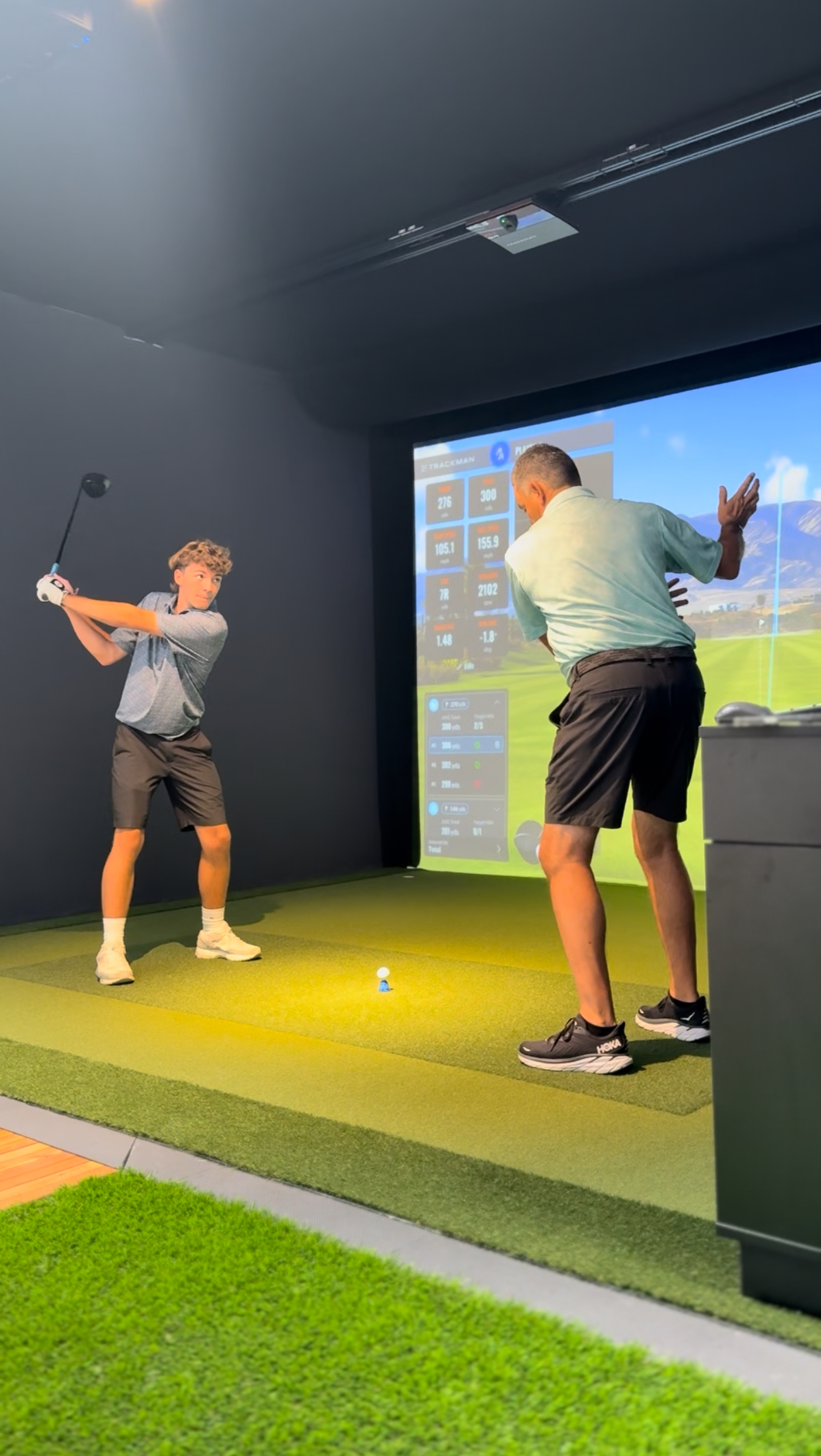
So let's start with the recreational golfer. The amateur golfer, goes to the range, buys a bucket of balls and smashes it in downrange. No idea what's happening, right? No idea what's happening in the golf swing. No idea what's influencing what all they're seeing is a ball flight, and they're trying to disseminate Well, what am I doing to achieve X ball flight, right? So bring them indoors and introduce technology. So any coach today who's not using some factor or form of a golf tracking device, and us put that loosely out there. So golf ball tracking, you are doing your students a disfavor. You have to have technology in the modern day, the good old coach standing on the range, watching with the eyeball and telling John, you're not doing this. You got to be doing that. Well, I would like to back that up with some data, right? So when you walk into my Bay, I use TrackMan technology, probably the best on the market. I run I'm the only guy in town who runs tmio units. So that's optimized for indoor and it's an overhead or flight monitor. So with that, you get all your data points, very simplistic ones, club, path, face to path, face angle, spin rates, launch angle, spin, loft attack angle, or angle of attack, if you like. So all of those things start playing a role of what are you doing with the golf ball? What is your swing producing to be able to project this ball somewhat towards the target, right? So we can use all of those things. Couple that in with camera and recording. Now we can do telestrations and comparisons. So I can take a model swing and Adam Scott, for example, and we can say, well, this is what he's doing in his swing in a slow motion type, frame by frame scenario. John, amateur golfer, this is what you're doing that's causing the issues and problems you're having. So let's start working on that, and we put a plan together, and then obviously, work on that. That's not That's the coaching, teaching side of the that business, that
Scott Groves 8:46
video software that you showed where it's like, angle of ankle, angle of knee, angle of this, like, all the stuff I was sitting there thinking, like the the thought pattern that goes into like a perfect golf swing, because you showed us that little overlay of what a perfect golf swing is supposed to look like. I was like, Oh my God. There's so much to think about. Think about. How does anybody ever hit a golf ball correctly? And it seemed overwhelming and daunting with the technology. I can't even imagine what it was 50 years ago where, like you said, the guy on the grass is just like, I think maybe you should change your knee angle a little bit. It just, it seems impossible without the modern use of technology.
Morne Bekker 9:21
So here's the thing, right? Even with an imperfect golf swing, you can still have a very good result. So always remember that it's not a one swing fits all right? We work with different body types, body shapes, sizing. You know, what's your natural sporting ability? All of those good things. There's certain key fundamentals, from a coaching point of view, that you want to install right? We've got to grip the club reasonably Correct. We've got to stand to it reasonably Correct. We've got to take the club back in a reasonably good fashion, right? To all of those things, and probably the most important part is sequencing. We're. And transition. Okay? Sequencing is, well, I've got a backswing and a downswing somewhere. We got to blend these two together. You can't have one thing happening and then another thing happening 10 seconds later. That's not going to happen. The goal swing is less than a second. So you got to understand sequencing and transition simplistically, as if think about throwing a baseball. Okay, we use our body and our hips to propel the motion towards the target, and the golf swing is not any different to that. We still got to move our body in a certain sequence towards the target to propel the golfer with speed.
Scott Groves 10:42
So when I saw Charlie, which was our my coaches, my jiu jitsu coach's daughter, is pretty exceptional in there, when she's getting, you know, 202 20 yards on a golf swing at 10 years old. Is that power? It's obviously not coming from her arms and her shoulders, right? Is that what you're saying? It's like hips. It's like throwing a fast ball.
Morne Bekker 10:58
She's using an entire body to propel, to generate speed, to propel the ball 200 yards through the air. That's wild. It's you're an athlete. Yeah, right? A golfer is an athlete, except
Scott Groves 11:12
for that really fat guy that smokes and drinks a lot, right? Well,
Morne Bekker 11:17
he's having fun. He's having fun. So, yeah, is that daily? Is that his name? John Daly, big dude. Yeah, he's, he's got phenomenal talent. I just,
Scott Groves 11:26
I just love seeing him on the golf course with all these guys that are just like, yoked, and they have, you know, V shaped back. And then this guy walks out there smoking a cigarette and just drills the ball. And I'm like, there are all types of shapes that can hit a ball
Morne Bekker 11:37
well 100% and to your to the point I made earlier, an imperfect golf swing. If you watch John Daley's golf swing and you compare that to a model swing, like a tiger woods or an Adam Scott, he is miles apart from that, but he's got phenomenal talent, hand eye coordination, understands sequencing, understands transition, and obviously he's with these the hand eye coord he has, and the talent he has with his hands, his short game is phenomenal, right? So there's different aspects to it, but that's the coaching side of the business. We also have the base just for, you know, relaxation and absolute recreational golf. So with that, there's in the technology itself. In the what we call TPS performance software, you can have a driving range with the data and just practice on that. There's various areas within practice. And then we've got over 520 golf courses worldwide that people can choose and play in the bay and simulate real conditions so you can be the fair weather golfer. No wind, dead calm, easy flags, easy pin positions, firm fairways or medium fairways and very soft greens. Or you can challenge yourself and actually turn up the wind with the software and make it really breezy, like Vegas conditions in springtime, you can make really firm and fast greens. You can have firm and fast fairways. The only thing I can't simulate in there is rain, okay, but everything else you can do in the bay.
Scott Groves 13:14
So if I want to come to your bay and say, today I want to play 18 holes on Augusta in a fairly windy day, I can replicate that experience in a bay, except for the Augusta Park, okay? Because Augustine is not loyal. Nobody's gonna license
Morne Bekker 13:29
that golf course. But you can come and play, pay well, beach, okay, that's one example. You can come and play St Andrews, the old course, the home of golf, and we've risk recently had old head, beautiful Irish links course in Cork in Ireland launch on the simulator.
Scott Groves 13:45
Phenomenal. So talk me through, like, the spectrum of people that come I'm sure there's the bachelor party that just wants to have a few drinks and whack a few balls all the way up to like, somebody that might be interested at some point in going pro. Like, what's the spectrum of people that you see there enjoying themselves
Morne Bekker 14:01
exactly what you just mentioned, Okay, everybody, and every golfer that's out there, it caters to all of that. It's for guys who just want to come and have fun and a bit of banter with their buddies and playing 18 holes on a Saturday morning when the weather's not ideal in Vegas, right? Perfect. Get indoors couple of hours, and you get through in 18 holes very, very efficiently. Guys can have a couple of drinks, they can have a good laugh, they can play some music, and it's all good fun. I have a youngster right now. Who is he started playing golf 14 months ago. He's about he's going to be the number one or two in the Liberty High School golf team that I've been teaching for for a little bit now. Phenomenal kid. He practices really hard, very serious about his game. So you have that aspect. You have the likes of Charlie right great ability to really concentrate on the game in a relatively quiet environment. Meant that's ideal for focused work, focused practice, focused approach.
Scott Groves 15:05
How long does it take somebody like me who's picked up a golf club maybe 10 times as an excuse to go smoke a cigar, you know, play best ball with the guys, have a drink, smoke a cigar, to be like, Okay, I could go out to the range and get proficient where I'm not chasing down a 90 degree slice, which is what I slice this to your rate, right? If I'm right in it, yeah, I've got, I've got a perfect 90 degree slice. So if you need to hit somebody in the bay next to you, I'm your guy. How long does it take, in general? I mean, can you get proficient in 10, 100 1000 hours of, like, simulation play with a coach? Like, what would the commitment be for somebody that's like, I think I want to pick up golf, or I want to go golfing with my boss. How long to like be able to hit the ball somewhat straight and not embarrass yourself?
Morne Bekker 15:48
Loaded question, yeah, of course, right? Loaded question, part of, part of it is, do you have some form of athletic ability? No, right. So then it's going to be a hard, hard row, right? Right. If, if anybody has played some sort of sport, basketball, football, baseball, tennis,
Scott Groves 16:08
does boxing in jiu jitsu count?
Morne Bekker 16:09
Boxing, you got to move. Right? Yeah, your body's moving and you've got coordination. That would count as athleticism. Okay, I feel better at myself now throw, pick up a ball and throw it. It's you got to have that sort of EMO, that motion skill to it once you've got that couple of lessons in in terms of, how do we hold, how do we stand, what do we need to do? How do we create motion in the golf club? And motioning in this in the swing? A lot of times, guys go to the range, and they will tell you at the end of the year. So let's take stock. We're in the middle or the beginning of 2026 so for 2025 I started off learning the game of golf. In January 25 I went to the range three times every week, and I'm still learning the game in December 2025 because there's no focus practice, right? That's the problem with going to the range and just hitting golf balls blindly, you probably not going to improve a heck of a lot. So if you work with your coach and you put a plan together and you are diligent in practicing on that plan, then that's going to be a much easier way to pick up the game and start becoming more proficient.
Scott Groves 17:28
How does the way I have to golf to get proficient? Like, once a week, five times a week. I'm just trying to think, like, what's the time investment, right? I'm also approaching 50. I don't have a lot of hobbies left in me, right? If it's something I got to commit 10 years too. So, like, it was very intriguing. When I was there, I was like, Oh, I could see, I could totally see getting into this, if nothing more, just like, as a fun way to go blow off some steam for an hour a couple times a week in the evening. But like, you know, I'm not talking about going pro. I'm not talking about playing with you. But just to, like, you know, go play with the guys and not embarrass myself. How many lessons would I need to get from you?
Morne Bekker 18:03
I would probably start off with the basics of five to 10 lessons. Okay, let's work through a system and a sort of foundational element, and we can crash course that in a couple of weeks, and then from there, it's probably a once a week for about a year. Okay, right, I got a year with some practice in between. Now, practice does not necessarily mean just hitting golf balls, okay? So in the golfing world, we talk a lot about drills. So if you like shadow boxing type scenario, right to describe that as a term. So do some drills actually practice the takeaway, practice just to grip the club. Practice the takeaway. Practice the through swing, right? So impact and post impact in the golfing terminology will. We'll call it p8 so position eight, where the shaft is parallel to the ground, target side, if you can sort of practice that in some drills, and then hit a few little shots like that in the bay or even outdoors, you'll quickly start progressing. The biggest risk people have is they watch and see what's happening on TV, and they see the elongated, long swing, and the club's up at the top, behind the guy's head, and now they want to try and mimic that off the bat. That's very difficult to do if you don't understand the Goldstone, right? So if you build it step by step, and good foundations, good fundamentals, yeah, it's not an impossible sport
Scott Groves 19:36
to pick up. And then, you know, when we were there, you did a little thing with Charlie, where you kind of took a video and you had all the data and you had all the metrics, and you're like, Okay, now just take your right hand, slide it down your hip to your knee, and think about that starting position. It was so technical, but like in the very first swing, it added 12 or 13 yards to her drive. I. Where does that come from? Does that come from just a lifetime of knowledge, or is there some software you're studying? Like, like, how do you get proficient as a coach? Because when I observe that, I was like, Oh, that's a master teaching somebody else. Like, it takes, it takes a level of mastery to coach other people
Morne Bekker 20:17
100% I mean, there's, there's multiple sources in the industry, right? So the PGA, for example, PGA of America Professional Golfers Association, they've got programs and training and all of those type of things. Golf Tech has got a fantastic training program. There's methodologies, and typically, all of us coaches, we follow certain individuals that have extensive knowledge in the game. So over the years, there's guys like David Ledbetter, phenomenal. Yeah. In town, you have Butch Harmon, arguably the number one coach ever, right. Lives here in Vegas. Lives in Vegas, nice. It's convenient. So you you sort of study what those guys have done, and learn from them, and learn all about the golf swing. So if you think about the golf swing, it's nothing else than a motor skill, a motor pattern, right? So if you understand a motor skill and a motor pattern and the physics around what influences the golf swing, and obviously, you follow some study, some book knowledge and some video analysis. You listen to what other top coaches are saying, and I'm not saying just follow them blindly. So have a critical eye to it that's important. So for example, a guy like Joseph Mayo has been instrumental in changing people's thoughts about how the short game is applied and taught, right, very con, very contradicting to what me, personally, I learned as a junior back in the early 1980s Okay, right, very different concept that Joseph is, or Joe's now, sort of with the help of TrackMan and the technology has been able to prove why this is a better methodology, right? So, so you always have to be open minded. You always have to learn. You always have to better yourself in your skill set to be able to help. And obviously the other golfers, amateur golfers out there. Hey guys,
Scott Groves 22:21
Scott groves, don't forget to like and subscribe if you're watching the podcast. And also want to give a shout out to two of our sponsors here in Henderson, ethereal Med Spa, a gym for your skin. Pretty much everything you can think of of like rejuvenating your skin and just having healthier skin looking better, also that helps. So shout out to ethereal Med Spa, and also Wright bet auto body. Scott, right, that's W, R, I, G, H, T, a great dude. Become a good friend of mine. Sponsors the show, sponsors our newsletter. So if you have a little fender bender, all the way up to getting a classic car rebuilt. Scott, right at right. Bet auto body is your guy. So I know Henderson was kind of chosen for you because your wife job moved out here. But what? What gave you the motivation or the desire or the courage, because being an entrepreneur is much different than just being on a corporate w2 job, what gave you the wherewithal to say, You know what, I'm going to do this massive build out of this thing, and I'm going to start my own business, and I'm going to do my own thing, because you shared with me some of the numbers and numbers, and you can show those if you choose to or not, some of the numbers of like building out those bays. It was, I'm guessing, not a cheap endeavor for you to start this.
Morne Bekker 23:30
No, it's not. It's again, it's, it's the passion you have. You have to have a passion and a love for what you do, otherwise you will not succeed. You also have to have to have a little bit of business savvy to yourself, right? So you got to be somewhat of a numbers person to understand how to balance a balance sheet and how does an income statement work. You have to, as a businessman, you know, there's revenue streams, and what revenue streams do I have, and what my expense items? And obviously you got to make those numbers work, right? But that's first and foremost thing, is the passion. So number one, I absolutely love golf. It's what I've been wanting to do my entire life. I had a quick double like I mentioned earlier in the pro ranks, probably too young and irresponsible at that time, youth is wasted. My young, 100% got into corporate. So my my schooling from a university point of view, college point of view, I'm a qualified accountant and auditor, right? That then pushed me into whilst I'm doing golf, and that pushed me into my other passion is technology. So I did computer auditing degrees and all of those type of things. And that's I ended up in the IT business with HP and NetApp driving, you know, sort of the technologies love that I had with all of those things. I love people. I love working with people. I love helping people to just be better and have more fun in life. So that's you've combined all of those type of things, golf simulation, with technology involved, and you playing golf and learning and using data to help be better at the game, that's an ideal fit.
Scott Groves 25:19
Did your wife ever tell you, Hey, let's skimp over here on the technology. And you were like, No, this can't happen. I have a technology background. She have to have the best
Morne Bekker 25:27
she's in the technology game as well. So absolutely, it's, ya know, you gotta, you gotta implement the correct technology, right technology. When you do a commercial studio or center like I've got, you can't go and put in your homegrown garage, model, type product, it's, it's not fair on your golfer, it's not fair on your customer. So you have to have really good, high end technology
Scott Groves 25:53
and and how does it work? Like, what model did you go with? Is it pay one off? Is it membership? Is it open? 24/7, like, what do you have as kind of an offering to the clients who who want to come to the studio? Yeah.
Morne Bekker 26:05
So basically, we have multiple options. And there's a normal Pay As You Go model where guys book a bay for an hour, two hours, three hours, and they pay for that time in the bay, um, up to a maximum of four golfers. So it's a four ball, same, same as outdoor golf, yep. So you can have four golfers in there. So that's a pay. Pay as you use type model, I have started growing quite a nice membership base. So membership, we start off with a very basic, simplistic membership option. That's a monthly membership fee. There's no contract to it, so it's by month by month. And with all of those, you get 24/7 access to the building. So guys can come in at two o'clock in the morning if they want, and come and practice their game.
Scott Groves 26:51
Interesting. They just have a little RFID or something. So all
Morne Bekker 26:55
app based on your phone, walk up to the door, tap your app, and the door opens up, closes behind you. I run guys through a very simplistic setup, how to open the bay, how to turn on the lights, how to turn on projectors. Basic troubleshooting is technology. Sometimes the ball flight monitor just doesn't register. The shot is very simplistic. Troubleshooting you can do in the bay to bring the connection back online, and guys can carry on That's wild. So that's all of those things. Then I have the coaching side, so that's purely without guys coming to me for coaching lessons, anything. Then obviously there's the lessons piece, right? There's two options. Guys can do monthly pay as well. So there's a membership option that gives you access to the facility unlimited T times plus two lessons a month, all the same with four lessons a month. And then I have some students that know they'll just take the basic membership and they buy lesson packs or plans from me.
Scott Groves 27:58
So and how was the lesson go? Because I got to think, with any athletic endeavor, there's like, diminishing returns, right? Like, somewhere around an hour and a half into Jiu Jitsu, I'm like, Okay, I'm not getting any more out of this. So if somebody is going to sign up for a lesson, usually keep those half hour, hour, two hours, like, what is, what is your normal recreational player looking at?
Morne Bekker 28:19
So adult wise, yeah, it's typically about 30 to 40 minutes, okay, right? Of instructional sort of coaching time, if you like, and then I leave a little bit of practice time. So basically, the golfer is going to be there in for an hour. We're going to do some, some real hard work for 3040, minutes, depending on how they're grasping the concept or in what we working on, and then a little bit of Bay time just to hone in that skill that we've just learned and make sure that pattern is sticking.
Scott Groves 28:53
You know, when we were with you, since obviously we had the pro with us, the number of stats on the wall after we hit each shot was overwhelming. Is there, like, a dumbed down version that you can teach people kind of how to coach themselves, where it's like, hey, just keep an eye on these three or four numbers. And these are, this is what you're trying to improve. Because when you were there, was great. You could walk us through everything. But, I mean, there was probably 24 different stats on the wall. I'm like, I have no clue what I'm
Morne Bekker 29:19
looking at. So 100% that's, that's that's where the coach relationship comes in. It's like we working on something very specific, and I want my student to focus on one or two numbers only. So I mean, you saw the bay, obviously you see the if we on the range in shot analysis, for example, you see the ball flight, you see the tracking and all of those type of things. You see all the data points. And maybe we have a split screen where we're looking at some sort of video or graphic or something, right? We can take all of that away and just put one number on the screen. Because a lot of times when you look at ball flight, people get so obsessed. With where the ball's going. They get target orientated, target focused, instead of process focused. So they're not actually improving, not working on what we're trying to achieve. Longer term, they want that instant result of, well, if I'm going to make this change, I want the immediate, great result. And unfortunately, like you would know from Jiu Jitsu, it doesn't happen like
Scott Groves 30:22
that, right? Because Can, can you hit a ball straight incorrectly? That sounds kind of weird. Yes, you can.
Morne Bekker 30:28
Okay, okay, little bit of luck involved, but yes, you can.
Scott Groves 30:34
So the two times I've drilled the ball correctly right down the middle of the fairway, that was an accident.
Morne Bekker 30:39
Well, it depends. I mean, you're aiming there Right, right? So the mind's strong, so you can, you can make it happen.
Scott Groves 30:47
What's been, like a big surprise to you, opening a business, just in general, or specifically here in Henderson, what's been kind of a big aha moment, good or bad, some
Morne Bekker 30:57
of the aha moments has been bad, is a little bit of bureaucracy. Okay, right? So when you start going through your application processes, your registration processes, and all of a sudden, out of the blue, that comes, oh, you need x, and it's like, well, that would have been nice if somebody had told me that up front Rose was a, you know, a golden handbook that you could follow step by step by step. So some of the stuff you just unfortunately have to sort of discover during the process, so, but it's all been good, so that was good, and we've worked through some of those things. And that was prior to opening.
Scott Groves 31:39
Is the golf community pretty small, like once the word got out, you know, kind of build it and they will come. Or has there been a lot more marketing than you anticipated?
Morne Bekker 31:49
There's the marketing has to take off a little bit more. Okay, so that's sort of where people are now. Only we've been open six months now, and yeah, we've had some good traction, but we need more, right? That's the bottom line to it, and it's sort of because we're on Raiders way close to the Raiders practice facility. A lot of people speed up that road and don't really pay attention to signage, right? So that's part of the sort of challenge we faced is just get our name in the market, referrals and word of mouth has definitely been the most success, isn't
Scott Groves 32:28
it crazy? That's always the way. That's always the way in the world of Instagram and Tiktok and Facebook ads and Google optimization and all this stuff, it's like, it's good people just saying you've got a good business that drives the traffic.
Morne Bekker 32:40
It's community. Yeah, right. So, if you think about my facility, this is the first one that we've opened here in Henderson. It's typically people that are within 1015, 20 minutes from the facility that's going to come there, right? Guy from Summerlin or, you know, Kyle canyon or sky Canyon, they're not going to drive 45 minutes to come and play indoor golf, right? So that's the sort of thing. So it's really close knit community. So if you think where we are in sporada, Anthem Highlands, Southern Highlands, sort of close to Bermuda, that sort of area, that's where most of the golfers that come to fly away swim golf. That's where they come from.
Scott Groves 33:27
And do you allow other coaches to bring their students? There is that, like, a big no no. Like, how do you, how do you work the politics out of that? Right? Because I know, like, I can't go to EOS or crunch fitness and bring my own trainer. They get very upset about that because, obviously, that's their business model. Is they're giving you an $8 membership, so hopefully you buy $100 coaching packages. Is that allowed, or is that kind of like shunned in the golfing industry? Is there a lot of politics with golf coaches?
Morne Bekker 33:53
So from a green grass facility, yes, you got to be sensitive to I mean, guys need to make a living, right? No doubt about that. So you got to be just sensitive to it. And any in our profession, any professional golfer, I'm not going to walk up to another pros green grass facility and just start teaching a student there. That's, that's, that's not the ethically right thing to do. Okay, if you have so, like, I have a relationship with Pam Bowers at Desert Willow. Pam has been phenomenal. She's got a fantastic Junior program. I've invited her to my studio, so when it gets cold and that or she wants to teach indoors, she's going to come and do it at fly away some golf. Likewise, I've got a little putting green inside the studio that I can do basic putting with. But if I want to do green reading teachings with a student, for example, or speed control of 3040 foot putts, that's not the ideal environment. We need a green, an actual physical green. So that's where you build a relationship outside of the studio. Golf Center, likewise, to the point I invite coaches to come and see me happy to have a discussion. We got to just make sure that we agree on the quality of instruction, because ultimately, you know, fly away some golf is the brand, right, and it might be John, who's coaching there, but people are simulated to my facility and the brand name so and it's, it's not a it's not a big no. It's just, let's just agree that we got to keep it professional, and we got to have quality instruction,
Scott Groves 35:36
nice and how much does somebody have to spend to get it golfing?
Morne Bekker 35:43
Well, his coaching, his lessons, you got to look the part. So you better dress properly, right? A lot of Travis Matthews, a lot of Travis Matthews, and all of those good brands. You need proper equipment. It can be it can get expensive, yeah, however, and I'll put this caveat out there. Just to learn the game, you don't need to go and spend $3,000 on a full set of golf clubs.
Scott Groves 36:08
I can pick up a you set at Goodwill or something.
Morne Bekker 36:12
Yeah, it's it's great to begin you can go buy a complete box set at one of the big box stores. It's great to just get into the game. As you improve, you're going to outgrow those, those box sets, or, you know, entry level equipment.
Scott Groves 36:30
So what's an entry level box set? Versus, like, I'm actually really good, and I want custom laser fitted for my body type, my so, like, what's the range between I'm gonna go pick up a set of clubs at Big Five. Versus, like, I want something custom made that fits my body, perfect. So big
Morne Bekker 36:45
box set or a box set at a big box store, you're looking something like 400 to $800 okay? That includes woods, so driver, fairways, hybrids, couple of irons and a putter and a bag, right? That's a full, complete set. Not bad. Hit me with the pro set. So when you go down the route of, okay, I now want to get fit. I'm getting better at the game. I want clubs that are fitted to me that matches my lie, angle matches my length, it matches my swing speed, if you like, although I don't like saying that, but let's call it shaft flex rather. So all of those good things, when you start looking down that road a set of ions is going to cost you somewhere around 1200 to $1,500 okay, that's basically seven irons. Okay, right. When you start looking at a driver, you in brand names. You in for about 550 to 700 for a stock driver, three woods or five woods. So fairway metals, as we call it, those are probably in the range of about 350 hybrids, about 272 80. And then putters can range anything from 300 to $300 all the way through to $1,000 a putter. Oh, so you could have a $5,000 bag, pretty easy. And then, if you talk about bags, and just a normal cart bag. You probably, at minimum, about 202 50, when you start getting into the name brands, like a vessel bag, for example. So your carry bag, or even a cart bag in vessel range, that's going to be probably north of 400 Okay, yeah, so it
Scott Groves 38:41
gets it gets a little pricey. It gets pricey. What type of business connections have you made on the golf range? Because I think about this for my son, where it's like, yeah, jiu jitsu is great, but even most jiu jitsu coaches will be like, the people working out here, they're not exactly the titans of business. When I think of like, where people are going to build relationships with other financial professionals say, like, obviously the old Mad Men idea of like playing on the golf course comes to mind. So has it been beneficial for you in business to be an exceptional golfer? Absolutely, really, no doubt. Is there a story that comes to mind?
Morne Bekker 39:18
So not to get into specifics of deals and stuff we struck on the golf course. And over the 20 plus years, I've was in corporate, when you're on the golf course with somebody and C suite level type people I've played with, CEOs, CFOs, you name it, CEOs, every single C suite you can think of, right? You learn the person's character, because you're spending four and a half five hours with that person on the golf course, right? So in that whole time, you're going to see them being ecstatic with a great shot. You're going to see them absolutely down and when they terrible at the game and hitting bad shots, you're going to see the temperamental shifts and move. Moves, you're going to see people's ethics and characters and morals when it comes to spending four and a half five hours with somebody on the course that helps you in the boardroom, when you sit across from somebody negotiating a deal or pitching a product or a solution or anything like that, you can look people in the eye and understand what is their trigger points? Yeah. So because
Scott Groves 40:24
there's somebody, it's already cheats in a meaningless game of golf, they'll charge on the motors. They'll definitely cheat when there's a lot of money on the line. 100% interesting. What is the golf community like in Vegas? Because I don't have any context for this. So it's like, is Vegas a big hot spot for golfers? Because of the weather. Is it kind of an afterthought, like, what's, what's kind of your total addressable market of golfers here in Vegas? Like, is it, is it a big deal here, or is it Golf is a big
Morne Bekker 40:51
deal in Vegas? Um, outdoor, outdoor golf. Key times are under pressure, right? What do you mean by that? So, supply and demand. Okay? Very simple. The supply is shrinking, the demand is rising, more people moving. Yeah, interesting. So obviously, we live in a water scarce environment, right? Water scarce community. So no new golf courses are being built. A lot of golf courses is closed down. Latest ones being Prim. The two courses out at Prim, there's a couple others that are earmarked for closure, that'll be development. And then you have some courses that are that used to be public facilities that are now going private and have closed down, and like bears, best, for example, is being renovated. New Course Design, new clubhouse is going to come in, but that's going to be private. So the supply of tea times to the general public out there that are not members of private country clubs, that supply is shrinking so and obviously, like I say, more demand. Couple with that is Vegas is also great for hosting college tournaments. So there's a couple every year out at Boulder Creek where we have the two d3 golfers coming in. There men and ladies coming to play. There you have southern highlands that hosts some of the d1 schools every year. So that's phenomenal. Great exposure for those kids and coming to play in in Sin City, so to speak, yes, right? So that's phenomenal. You have a lot of the the PGAS from different states that flock to Vegas when golf is terrible or no golf in snow based states that bring their members and come and host PGA pro AMS at some of the courses here in Vegas, didn't there used to be a PGA tournament here, correct? Okay. Shriners, that was a hell hosted at TPC Summerlin, yeah, many, many years. Yeah, that's unfortunately, plus the sponsorship, and with the Utah championship in Black Desert, it's sort of clashed a little bit. Yeah? So that tournament is no longer.
Scott Groves 43:11
The Shriner still goes though, right? But it's just not a PGA tournament. Yeah, yeah.
Morne Bekker 43:14
The tournament's gone. Oh, okay, yeah, tournament's gone. What do you think your
Scott Groves 43:17
business model is going to be going forward? Do you think it's going to be more coaching, or it's going to be more of the recreation? Recreational players? What are you seeing a trend towards? I can
Morne Bekker 43:26
see a lot more the recreational players. So to my point about outdoor golf. I mean, ultimately, we all want to play outdoor as much as we can, right? But with that supply showing 100% that's the greatest feeling. Is when you're standing on the first tee and ripping one down the middle, it's phenomenal, you know, and you you are out in nature. So it's not just about the golf. You actually see nature, and you experience sun on your skin, and that's great. But with that supply being under pressure, and a lot of people wanting to golf, a lot of people wanting to learn to golf, and there's a big element of golfers being a little bit sort of frowning upon those that want to enter into the game, right? So people feel intimidated. They come to an indoor facility where they can be private or semi private, and in a very sort of controlled environment, learn the game, pick up the game, yeah, and you can crunch through 18 holes, like me and my son will play 18 holes in 45 minutes. 40 minutes isn't that normally, like five hours. Outdoor golf is four and a half five hours. I guess you're walking, but you're traveling right there and back and all those sort of good things, right indoors, the two of us crash through in 4045, minutes. Got it? If I'm playing by myself, I get through 18 holes in about 2530 minutes. I don't know if
Scott Groves 44:47
that's good for all the guys that are trying to escape their family for four hours on Saturday.
Morne Bekker 44:50
Maybe, maybe not. However, if you're under pressure and you want to work at your game and you don't have four or five hours to spare, young families, fathers with young families. He has an exit where you can go and do an hour or two hours in a bay. Yeah, get a great experience. Learn use data, and you back home with a family before mom's too
Scott Groves 45:11
upset that that is what was appealing to me, because when I think about picking up the game of golf, I don't have four or five hours on Saturday or Sunday with the kids soccer and flag football and jiu jitsu tournaments. And now Gabriel's taking a welding class, and Alina is taking a horse riding class. It's like there is a 0% possibility that I could commit four or five hours on a weekend. And I hate being bad at things. Like, it sucks to suck. And so hey, if I'm if I'm gonna get if I'm gonna try something, I want to get good at it quickly, or at least competent at it quickly. And so that was so appealing to me. When you're like, Oh yeah, you can come in and play 18 holes in an hour. I was like, how is that? And I started doing the math. It's like, oh yeah. Most of golfing on a course is walking, it's not or driving the car or trying to find your ball, if you play like me, but being able to get through 18 holes in an hour sounds phenomenal.
Morne Bekker 45:59
That's phenomenal. And there's no lost balls, right? That's the best part. So he's saving on that as well.
Scott Groves 46:06
If you lose a ball in your bay, it's you're real bad at golf.
Morne Bekker 46:10
I've, I've had one of those. I had a young man come in and he actually hit a hole in the side wall, and the ball disappeared in the in the frame, in the build out, oh my gosh. But, I mean, that's the exception, right? But that's the thing you can you can really optimize your time in all of those good things. And when you think about a cost aspect, too, you pay a nominal fee for an hour in the bay, and you can be 234, golfers in there, right? If you think about what it costs outdoors for a single person in Vegas right now, you probably, if it's a good deal, you're getting it for about $75 per person.
Scott Groves 46:52
Yeah, I was just thinking about that. You figure travel time four of you to golf, probably 100 bucks each, right? You're gonna have a company to drink or eat out there. If you're me, you're gonna lose about a dozen balls. So, I mean, for a group of four, that's a five or $600 day. What can four people come golf with you for if they want to get through two hours on 18 holes digitally?
Morne Bekker 47:15
$100 $100 for two hours
Scott Groves 47:18
for four people. Oh, that's nothing. That's how much I spent on Starbucks, pretty
Morne Bekker 47:23
much, yeah, yeah, oh, that's amazing. So that, that's the whole beauty of indoor golf, and you can play it like I say. My members have got 24/7 access to will included in the monthly fee. They have basically unlimited golf, unlimited practice time, and then 24/7 Yeah, public, yes, we have business hours. Those are typically 8am to 8pm and in that time frame, it's $50 an hour to book a bay, and you can be one to four players, amazing.
Scott Groves 47:55
So what about you personally? Because I know from coaching people, because I coach sales people, like there I have a I have a shelf life when it comes to coaching people, for me to be focused on somebody else and really pouring into them. I've probably got about four or five hours a day where I can coach individually at a high level, and then quality starts to fall off. So where are you at capacity when it's like, you know, at some point, do you personally as a coach have to raise your prices or teach somebody to be a co coach, or do you already have other employees that coach? People like, When do when do you hit your capacity and still be able to work on your game and spend time with your family and all that
Morne Bekker 48:31
kind of stuff? It's a very personal thing. So for me, I don't like to do more than four lessons a day. Okay, right? It's, I'm not chasing that big number. Yes, it's not for me. I'd rather do four lessons a day, Max, and there's quality time with those students, right? So they get the best of my mastery, my skill, my involvement with them. By exception, I'll push it to five or six, but typically I'll cut off at four. Okay, it's, it's just not, it's not fair on them, right? And I don't want to be sort of dreading, right, getting to the bay and doing another lesson that's, that's the last thing I want to do. You don't want to turn your passion into misery, right? 100% not.
Scott Groves 49:18
And along those lines, can you, can you walk me through, like, a coaching plan, right? So somebody's a recreational golfer, maybe they hit the ball a few times, but they want to get better. Like, how does that work for you? Do you? Do you videotape them? Do you just have enough life knowledge to be like, this is where we're starting. Everybody kind of starts on the same plan. Or, how does that work?
Morne Bekker 49:38
You assess each golfer by its skill, right? So there's, there's not one sort of silver bullet or one that plan that fits everybody, so you have to customize it per individual, right? Very simplistically, you process wise. Student comes in, potential student comes in, put them in the bay, have them. Warm up a little bit, hit a few shots. Observe what's happening, observe the ball flight pattern, observe the motion, do a little bit of recording so you can have a meaningful conversation. Then you start using that recording with the data and the ball flight that you've seen consistently to form a picture for the student. Mr. Student, Scott, this is what you're doing, right? This is what's causing that ball flight. Then we have a meaningful discussion of, well, what's the objective? Where do you want to get to? What do you want to achieve? Because the worst golfer to teach as the guy comes in and say, simple, I want to get better at the game, or I want to be more consistent, consistent in what? Yeah, you can be consistently terrible. That's consistency. Or, right? I'm sick and tired of my slice. I'm tired of hitting the ball out of bounds. I'm tired of topping the thing. I want to
Scott Groves 51:01
be able to hit the ball straight so that I can win beer as a top golf that's my only goal. I want to be able to win at Top Golf so I can win free beer for my friends. There very simplicity, goalistic, right? Yeah. So somewhere between 50 and 150 yards, I just need to know what what club to pick up, and how hard to hit it, make it go straight so I can win beer. That's my goal.
Morne Bekker 51:22
It's very simple. That's a good objective. See, I'm simple man. Simple man, right? So first and foremost, we got to figure out how to teach you how to hit the middle of the club phase every time. Okay? Because you got to get this ball airborne, right, right? So we got to hit the middle of the club phase, and we got to control our path and I'll face your path to a degree, perfect. That's all we got to work on. And we'll put a plan in place to achieve those things.
Scott Groves 51:48
I gotta ask, since you moved here from South Africa to Henderson, what's any culture shock of being the United States or specifically, living in sin city?
Morne Bekker 51:58
Probably the biggest one for me is pronunciation of words. Okay, right? So the other evening, I'm in the bay, and I've got a aluminum frame South Africans, we talk like the British, and it's aluminum. I had no clue. People look at me as like, what did you just say? Wait one more time, aluminum, aluminum. So aluminum, yes, it's spelled differently. It's the same product, aluminum, okay, right? Another classic example is, we call it caramel. Americans, is Carmel. Okay, right? So from a especially when I'm teaching, I will talk about path, and a lot of my students will look at me the first time, if they don't know me and they have no idea what I'm saying. So then we go about swing plane path. Then it resonates, right? So from that's that's probably been the biggest adjustment, okay, from a just a conversational point of view, friends of ours. He's a pilot for Southwest, and his kids, when we met them seven years ago and started becoming friends, and that his kids would walk up to him and says, What did Mr. Becker just say
Scott Groves 53:13
it's the same same language. I promise the same language is just a different dialect.
Morne Bekker 53:19
But yeah, those are the type of things that that sort of hit out, right? Yeah. And you assimilate, and you you pick up, and you start pronouncing words differently, because that's the environment you're in.
Scott Groves 53:32
Anything surprising about doing business here, or how business is done differently,
Morne Bekker 53:38
the one aspect, and that's a bit that, when we moved over, we're still in corporate and corporate America till about 2022. Is how easy it is, and that's the cultural aspect we live in now to ghost people. So in South Africa, if you don't want to do business with somebody, you tell them, right? Or if you get an inquiry and you respond to it, if people come for, let's say, a job interview and you're not going to move forward with that candidate, it's a courtesy thing and a respectful thing to say thank you. But no, thank you, right? And depending on what the relationships are, maybe there's a little bit of explanation. The cultural shock, yeah, was like, people would just not answer. And especially in the corporate world, it's, it's, it's freaky how that's sort of set in, yeah, where people just, they'll just go quiet on me, like, no response, no feedback, yeah. And that, to me, is like, yeah, that's that's not the way human beings are supposed to be.
Scott Groves 54:47
There's a book that I read years ago called never split the difference by Chris Voss. He was a FBI hostage negotiator, and then he figured out, when he retired from the FBI that all these same skills work in business. You. And so he has a famous line. He's like, if somebody's been ghosting you for a long time, email, text, whatever, just email or text them, Hey, have you given up on? Have you given up on your membership here? Have you given up on coaching together? Because people in America hate being quitters, so culturally, they will ghost you, and they will ignore the email, and they will ignore the text. And then you say, Hey, have you given up on? And then insert whatever you're talking about, and they will respond in 10 seconds. Oh, hey, sorry. I've been meaning it back to you. Or, yeah, I'm so embarrassed I'm not wanting to do business with you or whatnot. The number of times I've used that email or that text to just bring closure to a situation, because you're right, it's like, there's nothing more infuriating than doing like, an exploratory call with somebody, and then you're kind of just flapping in the wind, like, are we doing business together? Are we not like I just, it's okay either way. I just need to know. But that has become a very American thing to just ghost people.
Morne Bekker 55:50
I think it's just a maybe, hopefully, a phase that's we in and it'll return back to decency, normality and all of those good things. But I like that, yeah, I like that strategy.
Scott Groves 56:02
Yeah, it tends to work. So what did I forget to ask you about flyaway sim golf, or what you're building there, or maybe some of the successes of your clients? What question did I forget to ask you before
Morne Bekker 56:13
we leave, Scott, it's when do I sign up? Yeah, perfect, perfect. So yeah, I mean, basically all our data, everything, all the information we have is online. On our website, there's a little write up about me as well. So that's all good there from we love meeting new people, so if people want to just come in and have a cup of coffee with us, that's also perfectly fine.
Scott Groves 56:39
You were very gracious when we came in. I appreciate you made the kids feel very comfortable. Obviously, Charlie spends her life on a golf course right now, but my kids, who had never picked up a club before, they felt very at home, very, very respected, like they weren't, you know, embarrassing themselves. So I appreciate that. It meant a lot to me,
Morne Bekker 56:55
100% and I'm glad you guys had that feeling so little bit about myself that you didn't know, or probably wouldn't find out. I belong to the biggest country club in South Africa, called the Country Club of Johannesburg, seven and a half 1000 members, right? I was the youngest club captain on the golf section ever, and I was the vice chairman before we left South Africa for the club. I was actually going to be the next chairman, but I had to resign because we were moving, yeah, yeah. And that's my whole point and goal with fly, with some golf, I want to create, ultimately, the indoor Country Club feeling that's where this whole thing is catered towards. So make kids feel welcome. Make families feel welcome. It's not the snobby, snooty, sort of old school country club type thing. It's orientated towards people being in the facility, having a good time. And it's sort of they can feel they belong to something. It's not just a transactional I'm paying my membership fee, and it's just to use it. You actually become friends, and you create this environment even between the members, where they start to get to know each other, and hopefully they get together and go and play golf outdoors as well. Yeah, because people are always looking for a foursome, right, correct? So that's, that's my whole goal with it is to create the and Henderson is just the first location. We've got plans to expand this, but to create that indoor golf simulation Country Club feeling and vibe. Well, I felt that
Scott Groves 58:34
when I walked in there, and then I really felt that when you were giving instruction to the kids. So I have a feeling and be picking up a golf club here soon, which I'm sure my wife will be excited that I have yet another hobby that takes me away. But do you think I can trick my wife into falling in love with golf something that we can do together as we get older? So let's do
Morne Bekker 58:52
a little family gathering for you guys. Okay, get the kids in and get yourself and your wife in, and we give you guys a couple of pointers. Do like, a little family lesson, if you like perfect and have just have some good time there.
Scott Groves 59:05
Okay, we'll book it as soon as we get off of that. Hey morning. Thanks for being in I appreciate it. Like, I really you're not paying me to say this. You're not paying me to advertise on Henderson HQ. I mean, you can if you want. But I just felt it when I was in there. Like, the energy is awesome, the location is awesome. You were absolutely great. I don't know anything about golf, but I know a lot about coaching, and I can tell you're an exceptional coach. So anybody who's looking to improve their golf game or get their kids into golf, please go check out flyway sim golf.
Morne Bekker 59:35
Scott, I appreciate that. Thanks for having me on your show this afternoon.
Scott Groves 59:38
Thanks. Hey, it's Scott groves with the Henderson HQ podcast. I hope you got something out of that episode. If you enjoyed it, please don't forget to like, comment and subscribe to the podcast. It really helps the show grow. And by the way, if you are a business owner, or you know, a business owner who has an interesting product, service or. Just an interesting back story. Please, please get in touch with us. Email us at the Henderson hq@gmail.com we would love to interview you, because that's what this show is all about. It's about building community, supporting local, individually owned businesses, and just making Henderson a great place to live. And don't forget, go to Henderson hq.com, and make sure you sign up for our newsletter. We send out a once a week newsletter, no spam, about the most interesting local businesses, hot spots, restaurants, community events. Thanks for watching the show. Really appreciate you. You.
Owner/Manager
With over three decades immersed in the game, Morné Bekker brings a rare mix of competitive experience, elite-level insight, and a true passion for helping golfers reach their full potential.
Morné’s journey began in South Africa, where he picked up a golf club at the age of 8 and never looked back. As a junior standout, he quickly rose through the amateur ranks, competing at a provincial level and later representing the prestigious University of Pretoria in national tournaments and at the legendary St Andrews during the Boyd Quach Invitational.
Even while building a successful corporate career, Morné stayed competitive—winning 6 Club Championships and continuing to battle it out in South Africa’s top amateur circuits.
In 2019, he and his family moved to the U.S., and by 2022, Morné left the boardroom behind to pursue golf full-time. Since then, he’s played in multiple PGA Tour Champions qualifiers, and recently advanced through Local Qualifying for the 2025 U.S. Senior Open.